How to Build a Wine Cellar at Home: A Full Guide
Madeleine Cruickshank
September 2, 2026 · 8 min read
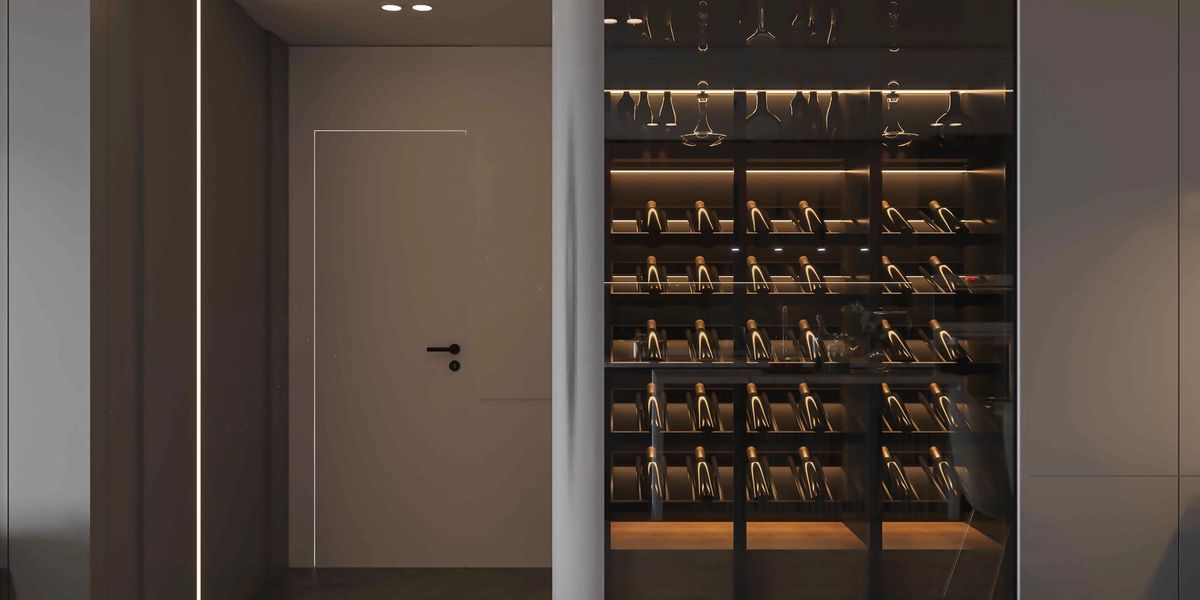
Where is the best place to build a home wine cellar?
The best location for a home wine cellar is an interior below-grade space with stable ambient temperature, no exterior wall exposure, and no direct sunlight. A basement corner away from the furnace and water heater is the classic answer for good reason: it's already cool, already dark, and already insulated on most sides by the earth around it.
The room you choose also needs an adjacent space that can absorb the heat your cooling unit will exhaust. This is the constraint most first-time builders overlook. A cooling unit doesn't destroy heat, it moves it, so the room next door needs to be large enough to dissipate it without simply heating up and making the cellar work harder.
Can you build a wine cellar without a basement?
Yes. A closet, spare room, or under-stairs space can all be converted successfully, though each requires more insulation work than a below-grade room because you're fighting a warmer, less stable surrounding environment. If you're not ready to commit to a full build, see our guide to storing wine without a wine cellar for the interim options.
What Temperature and Humidity Does a Wine Cellar Need?
A wine cellar should hold roughly 55°F and about 60 to 70 percent relative humidity, with stability mattering more than hitting exact numbers. For the full reasoning behind those targets and the common myths around them, see our wine storage temperature guide. The rest of this post is about how to actually build a room that holds them.
Insulation and Vapor Barrier
Why does a wine cellar need a vapor barrier?
A vapor barrier stops warm, moist air from migrating into your wall cavity and condensing against the cold cellar side, which would soak the insulation, destroy its R-value, and create exactly the conditions mold needs. Because a cellar runs cooler than the rest of the house, water vapor is constantly driven toward it, and the barrier is what interrupts that movement.
Placement is the single most commonly botched detail in a cellar build.
The vapor barrier goes on the warm side of the insulation, meaning the exterior-facing side, not the cellar side. Installing it on the cellar side traps moisture inside the assembly and causes the exact problem it was meant to prevent. When that goes wrong, the result is the mold and humidity failure covered in our guide to wine cellar mold and humidity problems.
Six mil polyethylene sheeting is the most common material, wrapped continuously around walls and ceiling, with seams overlapped and taped and every penetration (outlets, light fixtures, conduit) sealed. Closed-cell spray foam is the alternative worth considering, since it functions as both insulation and vapor barrier in a single application, removing the placement error risk entirely.
How much insulation does a wine cellar need?
Plan on a minimum of R-19 in the walls and R-30 in the ceiling, with higher values worth considering for any wall shared with an exterior or unconditioned space. Framing with 2x6 studs rather than 2x4 gives you the cavity depth to hit those numbers comfortably.
Fiberglass batts are the most affordable route but the least forgiving: gaps and compression can cost a substantial share of their rated effectiveness, so they need careful installation. Rigid foam board is easier to install well. Closed-cell spray foam delivers the highest R-value per inch and handles the moisture problem simultaneously, at higher cost.
Don't forget the floor. A concrete slab generally needs sealing rather than full insulation, but any floor with living or crawl space beneath it needs both insulation and a barrier.
Doors, Glass, and Sealing
An ordinary interior door will undermine an otherwise well-built cellar. Use an exterior-grade, insulated, solid-core door with a continuous perimeter gasket and a bottom sweep. When it's closed, there should be no perceptible airflow in or out.
Glass is a poor insulator, so keep any glass area small and specify double-pane, sealed, Low-E units. Single-pane glass in a cellar wall is a persistent thermal leak and, with some cooling manufacturers, will void warranty coverage.
Cooling Systems
What kind of cooling unit does a wine cellar need?
The three main types are through-wall (self-contained, venting into an adjacent room, simplest to install), ducted (the unit sits remotely and moves air through ducting, quieter in the cellar itself), and split systems (compressor located outside the space entirely, quietest and most flexible, most expensive and requiring professional installation).
Which one fits depends mostly on where you can put the heat and how much noise you'll tolerate in and around the cellar.
How do you size a wine cellar cooling unit?
Sizing is driven by the room's cubic volume, its insulation R-values, the amount and type of glass, and the ambient temperature of the surrounding space. Undersizing means a unit running constantly and still losing ground in summer; oversizing causes short-cycling and poor humidity control.
Run the final sizing through the manufacturer's own load calculator rather than estimating, since these are the inputs their models are built around and a specification error here is expensive to correct after the room is finished. For what happens when a cooling system ages out, see our guide to how long wine fridges and cooling units last.
How Do You Plan Wine Cellar Capacity?
Plan for meaningfully more capacity than your current collection, since most collectors fill a new cellar faster than expected, and account for large-format bottles up front rather than discovering later that nothing bigger than a standard 750ml fits your racking. See our guide to wine bottle sizes and rack fit for the dimensional planning, and our guide to choosing a wine rack plus our roundup of the best wine racks for collectors for the racking decision itself.
How Much Does It Cost to Build a Wine Cellar?
Cost is driven by room size, insulation approach, cooling system type, racking material and configuration, whether you're doing the work yourself or hiring a contractor, and any custom finishes. The cooling system and racking are usually the two largest line items in a residential build. Get itemized quotes rather than a single lump figure, since it makes it far easier to see where you can scale back without compromising the envelope, which is the part you genuinely shouldn't cut corners on.
How Do You Map a New Cellar So You Can Find Bottles?
Set up your digital cellar map as soon as the racking goes in, before you start filling it, since mapping an empty cellar is dramatically faster than reconstructing one already full of wine. InVintory's VinLocate builds a visual model of your actual rack, row, and bin layout, so any bottle can be located by search rather than by memory.
Map your new cellar from day one
Set up VinLocate in InVintory →
For the step-by-step setup, see our VinLocate setup guide or the getting started documentation. For larger builds where detailed reporting and custom 3D cellar modeling apply, see InVintory Elite. Once the cellar is built and mapped, our guide to organizing a wine cellar covers what comes next.
If you work through this and decide a full build isn't the right move, that's a legitimate outcome; see our roundup of the best wine fridges for collectors for the alternative.
Build the envelope right and the cooling system has an easy job for decades. Cut corners on insulation or the vapor barrier and no amount of cooling capacity will save it.
Ready to map your cellar the moment it's finished?
FAQ
Does a wine cellar need a drain?
Not usually for a residential cellar, though a cooling unit produces condensate that has to go somewhere, either a drain line or a condensate pump. Confirm the requirement with your specific unit's specifications during planning rather than after installation.
Can you use a regular air conditioner to cool a wine cellar?
No. Standard air conditioners are designed to cool and dehumidify to human-comfort levels, which typically means both too warm and far too dry for wine. They also aren't built to run at cellar temperatures continuously. Use a purpose-built wine cellar cooling unit.
Should a wine cellar door be insulated?
Yes. An exterior-grade insulated door with a full perimeter gasket and bottom sweep is standard for a cellar build. An uninsulated interior door is one of the most common weak points in an otherwise well-built room.
How long does it take to build a home wine cellar?
This varies widely with room size, whether you're hiring out the work, and lead times on cooling equipment and custom racking. The construction itself is usually a matter of weeks; equipment and racking lead times are often what actually set the schedule.
Does a wine cellar add value to a home?
It can, particularly in markets where wine collecting is common, though it's best understood as a feature you're building for your own use rather than a reliable financial return. Build it because you want it, not as an investment thesis.