The True Cost of Holding Wine: Fees Explained
Madeleine Cruickshank
September 9, 2026 · 8 min read

What does it cost to hold a bottle of wine for a year?
Holding fine wine typically costs somewhere between 1% and 3% of the bottle's value per year once storage and insurance are counted, before any transaction costs on the way in or out. Professional investors commonly aim to keep total annual carry under about 1% of portfolio value.
The full cost stack
Buyer's premium
Charged on entry, at purchase. Commonly 20% to 25% of the hammer price at major auction houses, sometimes tiered downward at higher prices. This is the largest single cost most collectors underestimate, because it hits before you own anything.
Professional storage
Charged annually. Roughly $20 to $40 per twelve-bottle case per year in a bonded warehouse. Consumer self-storage facilities charge considerably more, often $3 to $8 per case per month at standard tiers.
Insurance
Charged annually. Roughly 0.4% to 0.8% of insured value per year for standalone specialty coverage. Some bonded facilities include insurance in the storage rate.
Seller's commission
Charged on exit. Roughly 10% to 25% on smaller lots, often 5% to 15% for mid-value consignments, occasionally waived entirely on highly desirable lots.
Bid-ask spread
Charged invisibly, on exit. The gap between what a bottle is quoted at and what you can actually realize when selling.
What is a buyer's premium, and how much is it?
A buyer's premium is a percentage added to the hammer price and paid by the winning bidder, commonly 20% to 25% at major auction houses, and it is entirely separate from any commission the seller pays.
It is the most consistently underestimated cost in wine investing because it arrives at the moment of purchase, when attention is on whether you won the lot rather than on total outlay. A $2,000 hammer price is a $2,400 to $2,500 purchase.
Some houses tier the premium downward at higher hammer prices. Rates change, so check the specific house's current terms before bidding rather than assuming a standard figure. For the fuller bidding process, see our guide to buying wine at auction.
How much does professional wine storage cost per year?
Bonded warehouse storage typically runs $20 to $40 per twelve-bottle case per year, which on a $2,000 case works out to roughly 1% to 2% annually.
That per-case rate is the headline. Watch for the fees around it: handling or landing charges of roughly $5 to $15 per case on the way in, retrieval fees, cataloguing charges, and minimum monthly account fees. Facilities do not always advertise these, and for a collector moving stock frequently they can meaningfully exceed the base rate. Ask for a full fee schedule in writing.
Consumer self-storage wine facilities are a different tier of pricing, commonly $3 to $8 per case per month at standard service levels, which is several times the bonded rate.
There is a floor effect worth knowing: storage is priced per case, not as a percentage of value, so the cheaper the wine, the worse the ratio. A $30 annual storage fee on a $200 case is 15% a year, which is a guaranteed loss regardless of appreciation. Professional storage only makes financial sense above a certain bottle value.
What does it cost to insure a wine collection?
Standalone specialty wine insurance commonly runs 0.4% to 0.8% of insured value per year, and some bonded facilities include cover in the storage rate.
For the full picture on policy types, what insurers require, and how coverage differs between home and professional storage, see our guide to insuring a wine collection.
What commission do auction houses charge to sell wine?
Seller's commission commonly runs 10% to 25% on smaller lots, often falling to 5% to 15% for mid-value consignments, and is frequently negotiable on larger collections.
For how commission is actually negotiated, what auction houses look for, and the alternatives to auction, see our guide to selling wine from your collection.
What is the bid-ask spread on fine wine?
The bid-ask spread is the gap between the price a bottle is quoted at and the price you can actually realize selling it, and in fine wine it is wide, inconsistent, and rarely disclosed anywhere.
Unlike a listed security with a visible two-sided market, fine wine trades through auction houses, merchants, and private sales, each with different pricing and different buyer pools. The "market price" you see in an index or a valuation tool is closer to a reference point than an executable price. What you actually receive depends on which channel you sell through, how quickly you need to sell, and whether your provenance documentation is strong enough for a buyer to pay full value.
That last point is why documentation is a financial matter rather than an administrative one. A bottle with a verifiable storage history sells nearer the quoted price; one without takes a discount that functions as an additional, invisible cost of carry. See our guide to how wine provenance affects value.
There is no reliable published figure for typical wine bid-ask spreads, and anyone quoting a precise one should be treated with caution. What matters practically is planning for a gap rather than assuming you can realize a quoted valuation.
How much do these costs add up to over five years?
Here is the arithmetic on a single case, using the sourced ranges above. Substitute your own figures; the structure is what matters.
The purchase. One case of investment-grade Bordeaux, hammer price $2,000. Buyer's premium at 22% adds $440. Out of pocket: $2,440.
The holding period. Five years of bonded storage at $30 per case per year: $150. Five years of insurance at 0.5% of value: $50. Carrying cost: $200.
Total invested by year five: $2,640 on a case with a $2,000 hammer price. You are 32% down before the wine has done anything.
The exit. Selling at auction with a 12% seller's commission, the hammer price needed to recover $2,640 is $3,000.
What that requires. The case must appreciate from $2,000 to $3,000 over five years, a 50% gain, roughly 8.4% compounding annually, simply to break even.
That is the number worth sitting with. Not a loss scenario, a break-even scenario.
Does wine appreciation actually beat the cost of carry?
Sometimes, for the right bottles, and considerably less often than wine investment marketing implies.
The arithmetic above is not a pessimistic case. It uses mid-range figures from every sourced band. Push the buyer's premium to 25%, storage to $40, or seller's commission to 20%, and the required appreciation rises sharply. Buy a cheaper case and the fixed per-case storage cost becomes a far larger percentage drag.
Two structural conclusions follow. First, carry costs favor higher-value bottles, because storage is charged per case regardless of what is in it. Second, they favor longer holds only if appreciation actually compounds, since storage and insurance accrue every year whether the wine appreciates or not.
None of this means wine investment cannot work. It means the appreciation figure quoted in marketing material is a gross number, and gross is not what you keep. For what actually drives appreciation in the first place, see our guide to which wines hold their value, and for the ownership vehicles available, see our guide to how wine investment works.
How do you track carrying costs against a bottle's current value?
You need three things recorded per bottle: what you paid including premium, what it is worth now, and how long you have held it. Without all three, carry cost is unknowable.
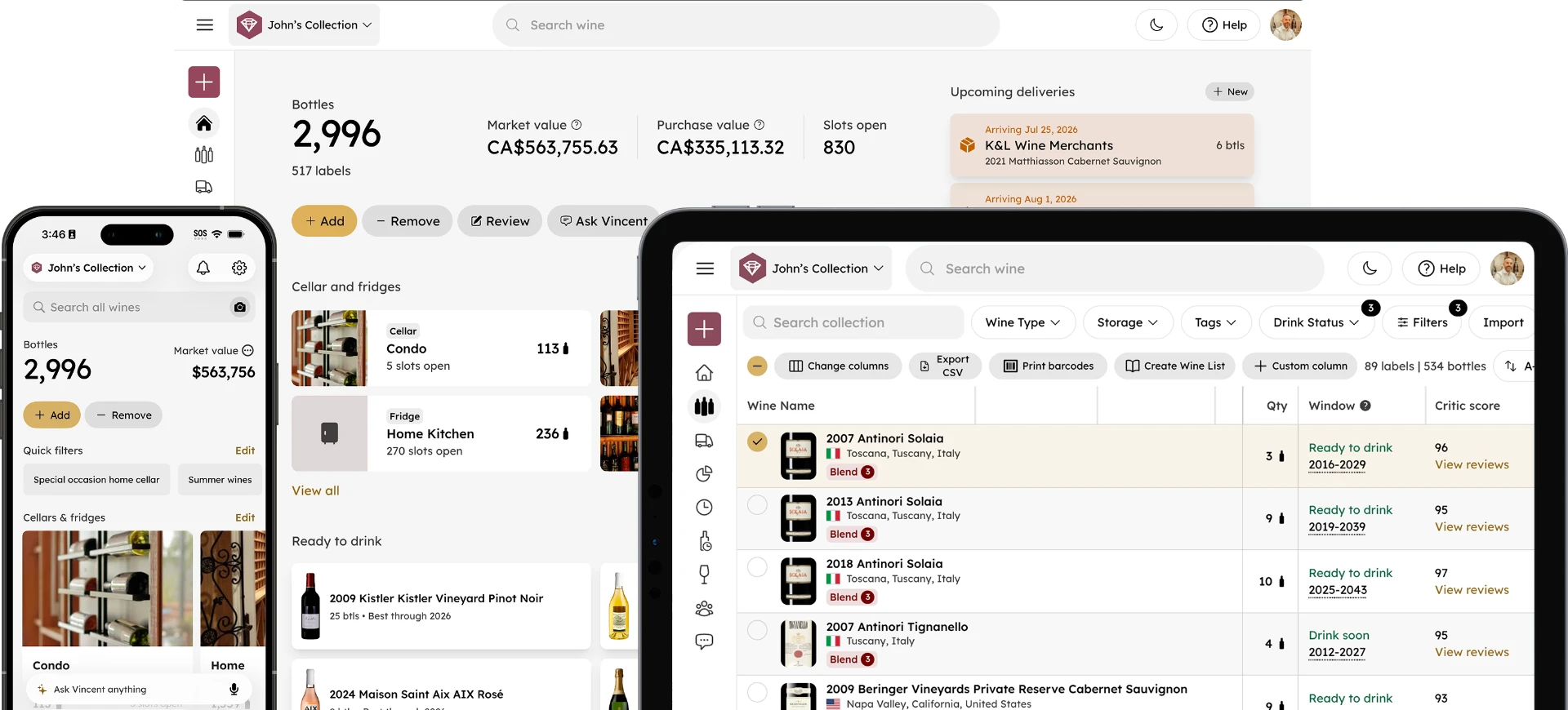
This is where a spreadsheet quietly fails. It records purchase price but not current value, so the gap between them, which is the only number that matters, has to be researched manually every time you want to look. InVintory records purchase price and date per bottle alongside continuously updated market valuation, which makes the carry calculation something you can actually see rather than reconstruct.
Track cost basis, current value and holding period per bottle: get started in InVintory →
For collections held primarily as assets, InVintory Elite adds deeper valuation and portfolio reporting. For more on automated valuation specifically, see our guide to tracking collection value automatically, and for the broader investment picture, our guide to investing in wine.
This post is general information, not financial advice. Wine is an unregulated, illiquid asset. Every figure here is a sourced range rather than a quote, and actual costs vary by provider, auction house, jurisdiction and collection. Confirm current rates directly before making decisions.
Cost of carry is not a reason to avoid holding wine. It is a reason to know the number before you assume the appreciation is yours.
See what your collection has actually cost you to hold.
Compare Free, Premium and Elite →
FAQ
What is cost of carry for wine?
Cost of carry is the total ongoing expense of holding a bottle: storage, insurance, and any account or handling fees, expressed annually. It excludes transaction costs at purchase and sale, which are one-off rather than recurring but often larger.
Is home storage cheaper than professional storage?
In direct cost, yes, since a home cellar or fridge has no per-case fee after the initial outlay. In resale value, often no, because bottles without documented professional storage typically sell at a discount, which functions as a deferred cost.
Do storage costs make cheap wine a bad investment?
Generally yes. Because storage is charged per case rather than as a percentage of value, the same fee is a small drag on an expensive case and a severe one on a cheap case. There is a value floor below which professional storage cannot make sense.
Can you avoid buyer's premium?
Not at auction, where it is standard. Private sales and merchant purchases carry different cost structures, though usually with margin built into the price rather than disclosed separately. There is rarely a genuinely fee-free route.