How to Insure a Wine Collection: A Collector's Guide
Madeleine Cruickshank
July 30, 2026 · 7 min read
Does homeowner's insurance cover a wine collection?
Most standard homeowner's policies cap collectibles coverage well below what a serious cellar is worth, typically between $1,000 and $2,500 total, which is why standalone fine wine policies exist. Homeowner's policies also commonly exclude the specific risks that damage wine most often, like mechanical breakdown of a cooling system, rather than just fire or theft.
Types of Wine Collection Insurance
Homeowner's policy rider
Some insurers let you add a rider or personal articles floater to an existing homeowner's policy, raising the coverage limit for wine specifically. This can work for smaller collections but often still excludes mechanical breakdown and temperature-related loss, the most common cause of wine damage.
Standalone specialty wine policy
A dedicated wine insurance policy, purchased separately from your homeowner's coverage, is built around wine's specific risks: temperature and humidity failure, breakage, theft, and sometimes coverage that follows the wine to a second home or off-site storage facility. This is generally the right choice once a collection grows past what a standard rider comfortably covers.
Scheduled, bottle-by-bottle coverage
For collections with individual high-value bottles, typically $500 or more each, scheduling insures each bottle at its specific appraised value rather than blanket-covering the collection at an average value. This is more precise but requires more detailed documentation upfront.
What Wine Insurance Actually Costs
How much does it cost to insure a wine collection?
Specialty wine insurance premiums typically run between $0.40 and $0.80 per $100 of insured value annually. A $100,000 collection would generally cost between $400 and $800 per year to insure, with the exact rate depending on your storage conditions, security measures, and collection size.
Collections stored in a professional, bonded storage facility often qualify for lower rates than the same collection stored at home, since third-party facilities typically have more consistent climate control and security than a home cellar. Alarm systems that monitor both security and temperature can also lower your rate.
What Happens When You File a Claim
A claim generally starts with reporting the loss to your insurer and providing your inventory documentation to establish what was lost and its value. For a partial loss, such as a cooling system failure that damaged a portion of a collection, an adjuster may want to inspect the affected bottles or storage area directly. For scheduled, bottle-by-bottle coverage, the claims process is usually faster and more straightforward, since the insurer already has an agreed value for each specific bottle rather than needing to establish value after the fact.
The single biggest factor in how smoothly a claim goes is whether your documentation was current before the loss happened, not after. An inventory reconstructed from memory after a flood or a fire is a much weaker starting position than one you already had on file.
Coverage for Off-Site and International Storage
If part of your collection lives somewhere other than your primary residence, a professional storage facility, a second home, or wine still in transit from an overseas purchase, confirm explicitly that your policy follows the wine rather than just covering a single location. Some standard policies default to covering only wine stored at the address on file, which leaves off-site bottles exposed unless you specifically request broader coverage.
This matters increasingly for collectors buying from European estates or at international auction, where a shipment can represent significant value while still in transit, a period when standard freight insurance from a shipping carrier is typically inadequate for fine wine's actual worth.
Common Mistakes Collectors Make With Wine Insurance
Assuming homeowner's coverage is enough
This is the single most common gap, and it's usually only discovered after a loss, when it's too late to fix.
Letting appraisals go stale
A policy sized for a collection's value from several years ago can leave you meaningfully underinsured if your collection has grown or if the wines you hold have appreciated since your last appraisal.
Not documenting storage conditions
Insurers price risk partly based on how well a collection is protected. Without documentation of your cooling system, security measures, or storage facility credentials, you may end up paying a higher rate than your actual risk profile would justify.
Treating insurance as a one-time setup task
A policy that made sense when you first bought it can become mismatched to your collection within a couple of years without anyone noticing, simply because nobody revisited it.
What Documentation Insurers Actually Require
A current inventory
A complete list of what you own, including producer, vintage, quantity, and purchase price, is the baseline requirement for any policy. Insurers use this to establish the collection's total insured value.
Proof of purchase where available
Receipts or purchase records support your stated value, particularly for higher-value bottles being scheduled individually.
Storage condition documentation
Insurers may ask about your cooling system, humidity control, and security measures, since these directly affect your risk profile and rate.
Periodic appraisal updates
Wine values shift, sometimes substantially, so insurers generally recommend updating your appraisal every two to three years, or sooner after a significant market move in bottles you hold in volume.
Using Your Collection Data to Support an Appraisal
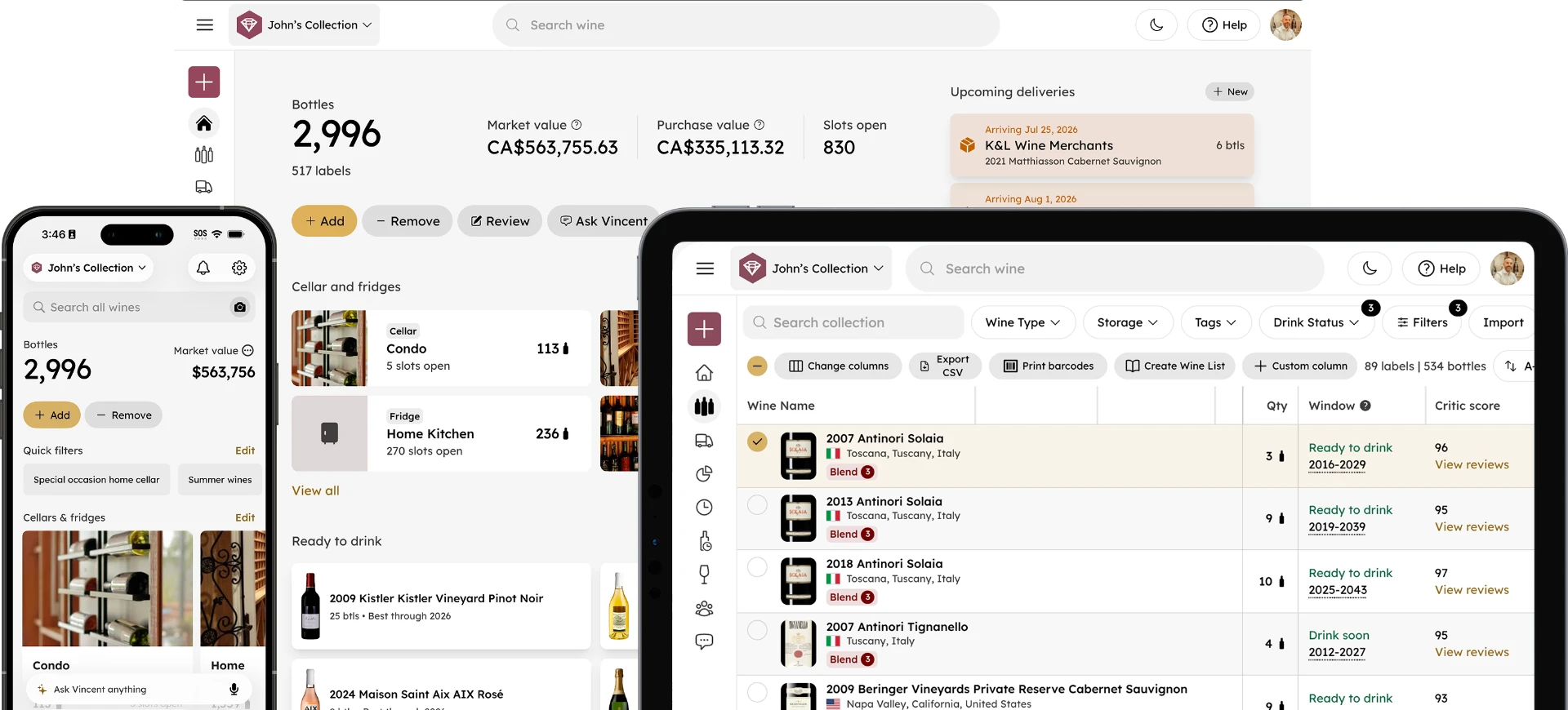
An insurer working from a vague description of "a few hundred bottles of wine" cannot underwrite a policy accurately, and you're likely to end up either overpaying or underinsured. A detailed, exportable inventory with current market valuation gives an insurer, or an appraiser working on your behalf, the specific information needed to price a policy correctly.
InVintory's Collection Analytics tracks real-time market value across your entire collection automatically, and the app's export tools generate documentation suitable for insurance appraisals, covering exactly the details, producer, vintage, quantity, current value, that insurers ask for.
Get your documentation ready before you need it: explore Collection Analytics in InVintory →
When to Update Your Coverage
Update your policy whenever your collection's value shifts meaningfully, whether from new acquisitions, bottles you've consumed, or market movement on what you already hold. A policy sized for a collection you owned two years ago may leave you underinsured or, less commonly, overpaying for coverage you no longer need.
For more on how market value shifts over time and what actually drives it, see our guide to which wines actually hold their value. If you're weighing whether to keep, sell, or drink a specific bottle, see our guide on when to drink, sell, or hold. And for the broader picture on wine as an asset, see our guide to investing in wine.
Insurance is one of the areas where good records pay for themselves directly, not just in convenience, but in the accuracy of the coverage you're able to get.
Ready to generate insurance-ready documentation for your collection?
FAQ
Is my wine collection covered under my regular homeowner's insurance?
Only partially, in most cases. Standard policies typically cap collectibles coverage between $1,000 and $2,500 and often exclude mechanical breakdown, one of the most common causes of wine damage.
At what collection value should I get a standalone wine policy?
There's no fixed threshold, but once a collection's value meaningfully exceeds your homeowner's policy's collectibles cap, a standalone policy or a significant rider is worth pricing out.
What's the difference between blanket coverage and scheduled coverage?
Blanket coverage insures your collection at an average value. Scheduled coverage insures individual high-value bottles at their specific appraised value, which is more precise but requires more detailed documentation.
How often should I update my wine collection's insurance appraisal?
Every two to three years is a common recommendation, or sooner if your collection's value has shifted significantly due to new purchases, consumption, or market movement.