How to Invest in Wine: A Collector's Guide
Madeleine Cruickshank
July 1, 2026 · 6 min read

Most wine collectors start the same way: buying bottles they love, aging a few, discovering that some have appreciated in value. At some point, the question shifts from "what do I want to drink?" to "what do I want to own?"
That shift is the entry point to wine as an investment. This guide covers what you need to know before treating your cellar as an asset class, including what makes wine investment-grade, how the market works, what the realistic returns look like, how to store and document for resale, and how to use InVintory to manage a collection with both drinking and financial goals in mind.
One important note before we begin: wine investment carries real financial risk. Returns are not guaranteed, the market is illiquid, and past performance does not predict future results. This post is educational and not financial advice. For investment decisions at significant scale, consult a qualified financial advisor or specialist wine investment firm.
Why Fine Wine Has Attracted Serious Investors
Is wine a legitimate investment asset?
Fine wine has a documented track record as an alternative asset class. The Liv-ex Fine Wine 100 index grew by 270.7 percent between 2001 and 2021, compared to 262 percent for the S&P 500 over the same period. Over a 15-year period, fine wine has delivered annualized returns of approximately 10.6 percent, which is slightly ahead of the stock market's long-term average, and with considerably different risk characteristics.
Fine wine has historically shown low correlation with traditional financial markets. During the 2008 financial crisis, wine prices dipped briefly but recovered faster than equities with less volatility. This makes wine a useful tool for reducing overall portfolio risk.
The structural reason for wine's investment appeal is supply dynamics. Wine gets consumed over time, which steadily shrinks the available inventory of older vintages and pushes prices higher. This scarcity of high-quality, investible wine is the core driver of wine's investment potential. Limited supply combined with global demand leads to price appreciation, particularly for wines with established reputations, critic recognition, and strong market trends.
Wine prices in early 2026 are showing signs of recovery after market corrections in 2024 and 2025, with industry experts noting that current prices represent attractive entry points.
That said, wine is illiquid, storage costs money, and the market can be opaque. Collectors who approach wine investment without understanding these realities tend to be disappointed.
What Makes Wine Investment-Grade
What kinds of wine are worth investing in?
Not every wine appreciates. Investment-grade wine shares several characteristics that distinguish it from the bottles that fill most cellar collections.
Age-worthiness
An investment wine must be built to improve over time. An investment wine should have all the traits of an age-worthy wine, but it also should be in demand when it sells. The most in-demand investment wines are fine Bordeaux and Grand Cru Burgundy.
Producer reputation
Wines from producers with consistent critical acclaim, limited production, and strong secondary market history appreciate more reliably than wines from unknown producers regardless of quality.
Critic scores and recognition
When Wine Spectator named Sassicaia 2015 its Wine of the Year, the price rose 25 percent in a single day. Scores and recognition drive demand in concentrated, powerful ways.
Regional provenance
Historically, Bordeaux's classified growths dominated the fine wine investment landscape. Today, the market has expanded dramatically: Bordeaux now represents less than a third of trade as investors explore a broader set of regions. High-performing, investment-grade wines now come from Burgundy, Champagne, Tuscany, Piedmont, California, and Australia.
Liquidity
New investors often make the mistake of buying obscure labels they personally enjoy. Focus on high-liquidity labels, or wines that trade actively on the secondary market and can be sold when you're ready to exit. Obscure bottles may appreciate, but finding a buyer is harder.
Understanding the Fine Wine Market
How does the fine wine market work?
The fine wine market operates through several channels, each with different characteristics for buyers and sellers.
Liv-ex (the London International Vintners Exchange) is the global benchmark for fine wine trading. Track indices like the Liv-ex Fine Wine 100 or the broader Liv-ex Fine Wine 1000 reflect real merchant transactions and give wine investors insight into what's actively trading.
Auction houses are the primary exit for rare and high-value bottles. Sotheby's and Christie's attract global buyers and can achieve top prices for exceptional bottles. Auction commissions typically run between 10 and 25 percent, which matters when calculating net returns.
Wine investment platforms like Vinovest and WineCap offer managed approaches; they handle authentication, storage, insurance, and eventual sale, making wine investing accessible to collectors who want the financial exposure without the physical complexity.
Merchants and brokers provide access to en primeur wine (futures purchased before bottling), which can offer attractive entry prices on wines that haven't yet been released.
How to Buy Investment-Grade Wine
How should I approach buying wine as an investment?
Buy by the case, not the bottle
Most wine auction sites prefer to sell wine in sets of 3, 6, 12 and 13. By purchasing 3 or more bottles, you also give yourself the opportunity to start collecting verticals of single wines. A complete case with consistent documentation also inspires more buyer confidence than individual bottles.
Build provenance from day one
When buying in this market, buy by the case and do everything you can to create a paper trail of provenance to show the wine is not fake. Provenance, or the documented storage history of a wine, is what separates a bottle worth top auction prices from one that trades at a discount.
Consider storing in-bond
Storing wine in-bond in a government-regulated, temperature-controlled warehouse is the only way to guarantee provenance. A bottle that has left the bonded circuit is immediately worth less to a future buyer because its storage history is broken. In-bond storage also defers duties, which matters when wine crosses international markets at sale.
Hold for the medium to long term
Fine wine is generally classed as a medium to long-term investment. WineCap recommends holding wines for at least three years, though many investors choose a horizon of five to fifteen years.
Storage and Insurance
What storage do wine investors need?
Storage is the most important operational decision for wine investment. Temperature fluctuations, humidity problems, UV exposure, and vibration can all degrade wine irreversibly, and a damaged bottle is worth nothing on the secondary market.
The baseline requirements are consistent temperature around 55 degrees Fahrenheit (13 degrees Celsius), humidity between 60 and 70 percent, no direct light, and minimal vibration. Professional off-site storage in a climate-controlled, insured facility is the right choice for serious investment wine.
Insurance is equally important. A standalone wine insurance policy often costs about $0.40 to $0.80 per $100 of insured value per year. Specialist insurers offer policies tailored to fine wine collections, sometimes with low or zero deductibles. For high-value investment bottles, insurance is not optional.
Tracking Your Investment Collection in InVintory
How do I manage an investment wine collection alongside a drinking collection?
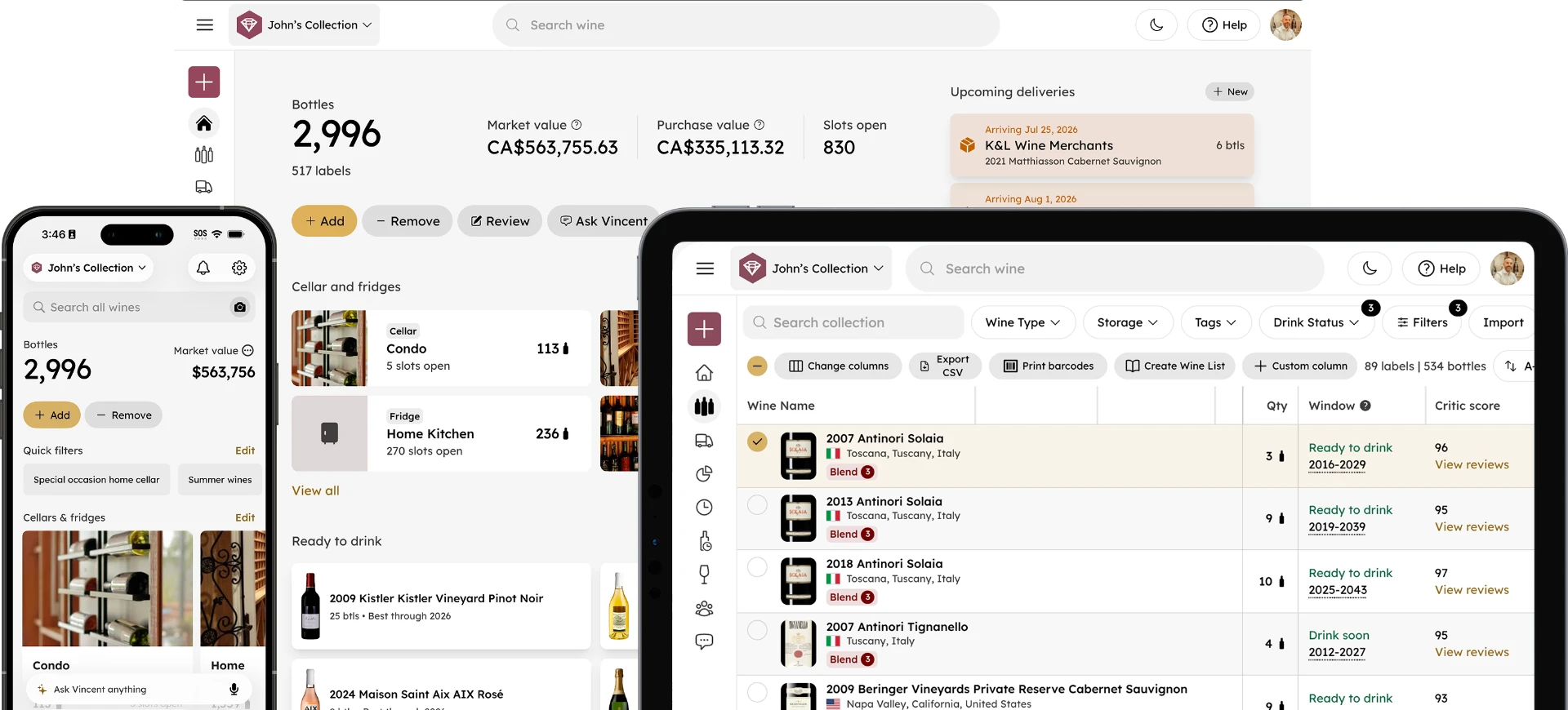
InVintory gives you the tracking infrastructure that wine investment requires. Market prices are tracked automatically for every bottle in your collection, drawing from institutional-grade fine wine price data. Collection Analytics shows your total collection value, spend by region, and distribution across styles and vintages. The export feature generates documentation suitable for insurance appraisals.
For collectors managing a mix of drinking wine and investment wine in the same cellar, InVintory's Saved Lists let you create a dedicated investment list that separates your held bottles from your everyday rotation. You can track purchase prices, monitor appreciation, and use VinLocate to assign precise cellar locations to ensure investment bottles are stored correctly and never accidentally opened.
For more on the decision framework around when to drink, sell, or hold any bottle in your collection, this post on the collector's decision framework covers the logic in detail.
Track Your Collection's Value in InVintory →
When to Sell
When is the right time to sell investment wine?
Wines reach peak value near their optimal drinking window. Wait too long and value declines as wines become too old for most buyers. The right time to sell is when a wine is approaching its peak: demand is building, the wine is gaining media attention from critic scores and vintage anniversary coverage, and buyers are actively looking.
Watch for favorable conditions like anniversary vintages, critical score releases, or themed auction events that create buyer interest. The 2005 and 2010 Bordeaux vintages are examples where anniversary interest drove meaningful secondary market activity.
The practical exit options are auction houses (best for rare and high-value bottles), wine merchants and brokers (faster and less complex than auction for standard cases), and wine investment platforms (for collectors who prefer a managed exit).
Frequently Asked Questions
Is wine a good investment in 2026?
Wine prices in early 2026 are showing signs of recovery after market corrections in 2024 and 2025, with industry experts noting that current prices represent attractive entry points. That said, wine investment is a medium to long-term proposition and carries real risk. It is most appropriate for collectors who already have a diversified financial portfolio and are adding wine as an alternative asset.
How much do I need to start investing in wine?
There is no required minimum, but meaningful wine investment typically starts at a few thousand dollars per case for entry-level investment-grade bottles. Platforms like Vinovest allow entry at lower minimums through managed portfolios. Quality matters more than quantity at the start; a few cases of well-documented, provenance-assured wine from strong producers is a better foundation than a large collection of uncertain quality.
What regions produce the best investment wines?
Bordeaux, Burgundy, and Champagne consistently anchor most serious wine portfolios. Napa Valley and Barossa Valley are gaining real ground with global investors as their reputations for premium production continue to build. Tuscany (particularly Super Tuscans) and Piedmont (Barolo and Barbaresco) are also frequently cited as strong performers.
How do I track the value of my investment wine?
InVintory tracks market prices for every bottle automatically (more on how InVintory sources its wine market data in this blog post). Collection Analytics shows your total collection value and how it has changed over time. For index-level market data, Liv-ex provides pricing indices and trading volume charts that help identify when a wine may be over or under-priced.
Is wine investment regulated?
Wine investment is generally not regulated in the same way as financial instruments, which means investor protections that apply to stocks and bonds may not apply to wine. This is an important consideration before committing meaningful capital. Consult a qualified financial advisor before making significant wine investment decisions.
The collectors who build the most valuable cellars over time do so intentionally, and with a clear view of what they own, what it's worth, and when to act. InVintory gives you the data layer that makes that clarity possible.