How to Buy Wine at Auction: Collector Guide
Madeleine Cruickshank
August 29, 2026 · 6 min read
How does buying wine at auction actually work?
Register with the auction house, review the condition report for any lot you're interested in, set a maximum bid for yourself in advance, bid, and if you win, pay the hammer price plus the buyer's premium plus any applicable tax and shipping, then arrange transfer to your own storage or a facility of your choice. Each of those steps has its own details worth understanding before you commit real money to a lot.
What Is a Buyer's Premium?
A buyer's premium is a percentage fee added on top of the hammer price, charged by the auction house to the winning bidder, separate from any commission the house charges the seller. Buyer's premiums commonly fall somewhere in the 20 to 25 percent range at major international houses, sometimes on a tiered scale where the percentage drops for higher hammer prices, though exact rates vary by house and change over time. Always check the specific percentage on the house's current terms page before bidding, rather than assuming a standard rate applies.
Is auction cheaper than retail?
Not necessarily, and sometimes it's meaningfully more expensive once you add up the full cost. The hammer price alone can look attractive next to a retail shelf price, but once you add the buyer's premium, applicable sales tax, and shipping, the all-in cost can equal or exceed what you'd pay a retailer, particularly for a bottle that's reasonably available through normal retail channels. Auction tends to make the most financial sense for rare or hard-to-find bottles that simply aren't available any other way, rather than as a general discount shopping channel.
What Should You Check in a Condition Report Before Bidding?
Check the fill level (how much wine remains relative to the original volume, often called ullage), the label and capsule's physical condition, any documented storage history, and whether the report notes seepage, cork movement, or other signs of past stress. A thin or vague condition report is itself a signal, a house confident in a lot's condition typically provides real detail rather than boilerplate language.
What does fill level or ullage actually tell you?
A lower fill level than expected for a bottle's age can indicate a compromised seal at some point in its life, which raises the risk that oxygen has affected the wine inside, even if nothing looks visibly wrong from the outside. Some fill loss is normal and expected for genuinely old bottles; unusually low fill relative to a bottle's specific age is the detail worth flagging.
Using Provenance as a Bidding Filter
Provenance isn't just something to document after you own a bottle, it's a filter to apply before you bid. A lot with a documented, continuous storage history, especially from a known collection or a professional, temperature-controlled facility, carries meaningfully less risk than an unattributed lot with no stated history, even at the same hammer price. For the full picture on what makes provenance strong and how it's verified, see our guide to wine provenance and value; this post assumes that background and focuses specifically on applying it as a pre-bid filter rather than explaining it from scratch.
If a lot's provenance is thin or unstated, that's not automatically a reason to walk away, but it should factor into your maximum bid, since you're taking on more uncertainty than an equivalent, well-documented lot.
How Do You Avoid Buying Counterfeit Wine?
Favor lots from reputable auction houses with established authentication practices, scrutinize condition reports and provenance documentation closely rather than bidding on instinct, and be especially cautious with older, rare, or high-value bottles that lack a clear, continuous ownership history. Counterfeiting risk rises sharply with a bottle's rarity and price, so the more a lot is worth, the more scrutiny its documentation deserves before you commit.
Arranging Transfer After You Win
Once you've won a lot, decide in advance whether you're having it shipped to your home, transferred directly to a professional storage facility, or held at the auction house temporarily while you arrange logistics. For higher-value wine, shipping directly to climate-controlled storage rather than a home address, even briefly, avoids an unnecessary period of uncontrolled temperature exposure right after the wine has already changed hands. If you're planning to hold new acquisitions offsite, see our guide to tracking wine stored offsite for how to set that up correctly from day one.
Logging an Auction Lot Correctly
Once you've won a lot, record the details while they're fresh and complete: purchase price, buyer's premium paid, the auction house and lot number, condition report notes, and any provenance documentation that came with the sale. This is exactly the kind of record that's easy to skip in the moment and hard to reconstruct later, and it's the same documentation you'll want if you ever insure, appraise, or resell the bottle.
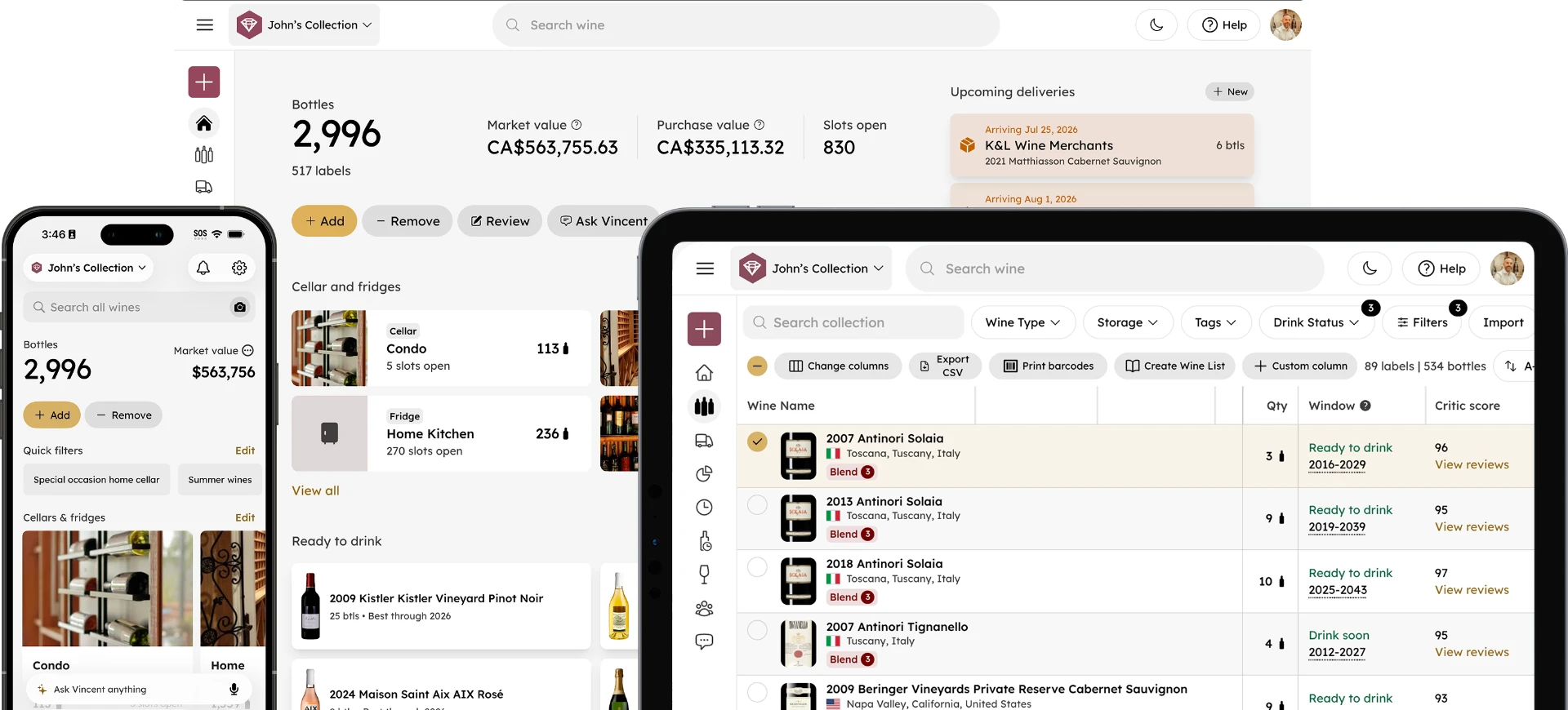
Record your winning bids with full provenance intact.
For collectors bidding on higher-value lots who want more comprehensive documentation support, see InVintory Elite. And before you bid on something that might duplicate a bottle you already own, or that you're not sure fills a genuine gap in your collection, ask Vincent to check what's already in your cellar.
Check your existing collection before you bid.
For the other side of this transaction, see our guide to selling wine from your collection, and for how a new acquisition affects your overall collection value, see our guide to which wines actually hold their value. If you're insuring a newly won lot, see our guide to insuring a wine collection.
This post covers general information about how wine auctions typically work and isn't legal, tax, or investment advice. Rules, fees, and requirements vary by auction house and jurisdiction, and specific figures should always be confirmed directly with the house you're bidding through.
Buying well at auction isn't about winning the lowest hammer price. It's about understanding the full cost and the full risk before you raise your hand.
Ready to track every auction win alongside the rest of your collection?
FAQ
Do I need to be a professional collector to bid at a wine auction?
No. Most auction houses, including major online platforms, allow any registered bidder to participate, though larger or more prestigious houses may have their own registration requirements.
What happens if I win a lot and then find a problem with it?
This depends entirely on the specific auction house's terms, which typically limit post-sale disputes to cases where the lot was materially misrepresented in the condition report. Review a house's specific return and dispute policy before bidding, not after.
Are online wine auctions as reliable as in-person ones?
Reputable online platforms generally maintain similar authentication and condition-reporting standards to traditional houses, but reliability varies by platform, so research a specific site's reputation and track record before bidding significant money.
Should I set a maximum bid before an auction starts?
Yes. Deciding your ceiling in advance, based on the all-in cost including buyer's premium and tax, helps you avoid getting caught up in bidding momentum and paying more than the lot is actually worth to you.