How to Track Wine Stored Offsite in InVintory
Madeleine Cruickshank
August 28, 2026 · 6 min read
How do you track wine stored somewhere you cannot see it?
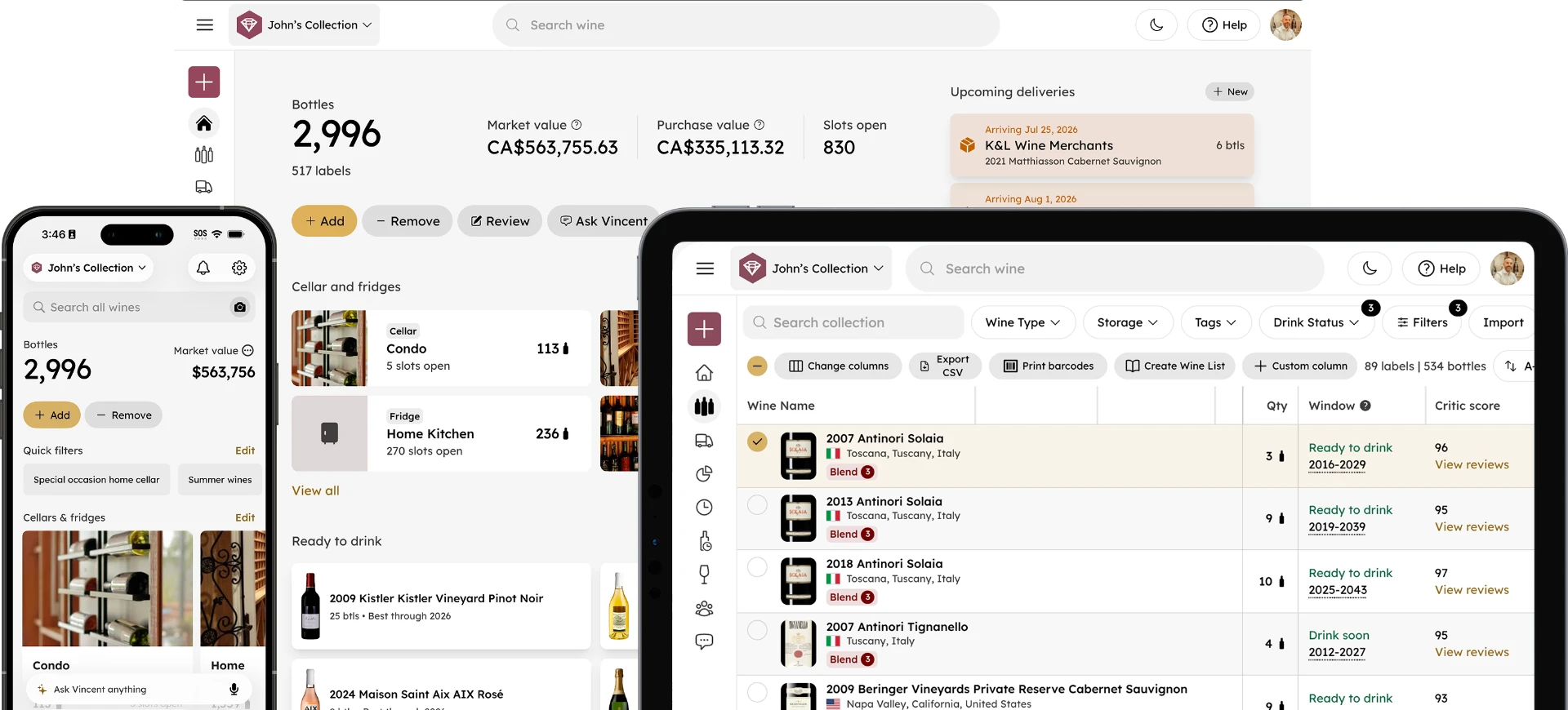
Create the offsite facility as its own storage location, and treat the facility's own manifest, not your memory, as the source of truth for what's actually in it. You don't need a visual, room-by-room map of a space you can't physically survey; you need an accurate, regularly reconciled record of what's there.
Should Offsite Bottles Live in the Same Collection as Your Home Cellar?
Yes, because your collection is one collection regardless of where individual bottles physically sit. Keeping offsite bottles in the same InVintory account as your home cellar means your total bottle count, total value, and drink-window tracking all stay accurate across everything you own, rather than requiring you to mentally combine two separate systems.
To keep the two visually distinct day to day, name and label offsite locations clearly, something like the facility's actual name rather than a generic label, so it's immediately obvious at a glance which bottles are physically with you and which aren't.
Setting Up an Offsite Location as Its Own Storage Record
Add the storage facility, second property, or restaurant locker as its own named location within your collection, the same way you'd add a home cellar or wine fridge, but without building out a room-by-room visual map, since VinLocate's visual mapping is built for spaces you can physically survey and measure. An offsite location functions instead as a manifest: a list of what's there, without the visual rack-and-bin layout.
What to Look for When Choosing an Offsite Facility
Not every storage option is equally worth documenting carefully. A professional, bonded facility with consistent climate control and a track record of accurate record-keeping is worth the setup effort described above. A casual arrangement, a friend's basement, an unmonitored storage unit, is worth being honest with yourself about: it may be convenient, but it won't carry the same provenance weight if you ever need to demonstrate continuous, professional storage for an insurance claim or a sale.
How Do You Reconcile Your Records Against a Storage Facility's Manifest?
Compare your logged inventory for that location against the facility's own manifest on a regular cadence, ideally at least once or twice a year, and immediately after any bottle is added, removed, or transferred. Facilities do occasionally make errors, and a mismatch caught early is far easier to resolve than one discovered years later when you're trying to sell or insure the collection.
What Should You Record When a Bottle Goes Into Professional Storage?
At minimum, record the intake date, the facility name, your account or locker reference number, and the condition the bottle was in when it went into storage. This record becomes part of the bottle's provenance, and it's exactly the kind of detail that's easy to skip in the moment and difficult to reconstruct accurately later.
How Far Ahead Do You Need to Request a Bottle From Storage?
This depends entirely on the specific facility, so confirm your facility's actual lead time rather than assuming a standard turnaround, and plan your drinking or hosting occasions around that constraint rather than discovering it when you need a bottle quickly. Some facilities can turn around a request in a day or two; others, particularly for deep, less-accessed storage, need considerably more notice.
If you know you'll want a bottle for a specific occasion, request it well ahead of that date rather than close to it, and build that lead time into how you plan what to open for anything time-sensitive.
Ask Vincent what's ready to drink among your offsite bottles before you request a withdrawal.
Try InVintory's AI Sommelier →
Does Offsite Storage Help or Hurt Resale Value?
It generally helps, provided it's documented properly. Continuous, professional, temperature-controlled storage is exactly the kind of provenance buyers and appraisers look for, since it addresses the biggest hidden risk in an unknown bottle's history: whether it was ever exposed to damaging conditions. The benefit only materializes if the storage history is actually documented, though, an undocumented claim of "it was in storage" carries far less weight than an actual facility record. See our guide to how wine provenance affects value for more on what buyers and appraisers actually look for, and our guide to selling wine from your collection for how this plays out at the point of sale.
Keeping Your Whole Collection, Wherever It Lives, Properly Insured
Bottles held offsite still need to be covered by your insurance, and coverage details can vary by location, so confirm explicitly that your policy follows the wine rather than covering only your primary residence. See our guide to insuring a wine collection for the specifics on off-site and multi-location coverage.
Set up your first offsite location
For collectors with significant holdings in professional storage, InVintory Elite offers more comprehensive documentation support for exactly this scenario. If you're mapping a home cellar you can physically measure alongside offsite holdings, see our VinLocate setup guide for that side of your collection, and if you're just starting to think about storage you don't yet own, see our guide to storing wine without a wine cellar.
A collection isn't defined by which room it's sitting in. It's defined by the record you keep of it, and that record needs to cover every bottle, wherever it actually lives.
Bring your entire collection into one accurate record.
FAQ
Can I track bottles in more than one offsite location at once?
Yes, each offsite facility, second home, or locker can be set up as its own named storage location, so your records stay organized by where bottles actually are, even across several separate places.
Do I need to visit a storage facility to keep my records accurate?
No, that's the core advantage of tracking offsite storage by manifest rather than visual mapping. Periodic reconciliation against the facility's own records keeps your inventory accurate without requiring a physical visit.
Is offsite storage only worth it for very large collections?
Not necessarily size alone, it's more about whether your home storage has the space and climate control a specific bottle needs. A smaller collection with a few especially valuable bottles can benefit from offsite storage just as much as a much larger one.
What happens to my records if I move bottles from offsite storage back home?
Update the bottle's location the same way you would any other move, from the offsite facility to your home storage record, so your collection stays accurate and the bottle's documented history carries forward rather than resetting.