Wine Indices Explained: Liv-ex and Pricing
Madeleine Cruickshank
September 16, 2026 · 8 min read
What is a fine wine index?
A fine wine index is a benchmark that tracks price movement across a defined basket of wines, built from trade data rather than from asking price, and it tells you how a market segment moved, not what your specific bottle is worth.
That distinction runs through everything below. An index is a measurement instrument pointed at a market. It is not a valuation of your cellar, and treating it as one is the most common mistake collectors make with this data.
What Liv-ex Actually Measures
Liv-ex, the London International Vintners Exchange, was founded in 2000 by two stockbrokers, James Miles and Justin Gibbs, with the explicit aim of bringing exchange-style transparency to a fragmented wine trade. Its indices are built from Liv-ex Mid Prices derived from real merchant transactions on the exchange, which is what separates them from indices built on listed asking prices.
What is in the Liv-ex 100?
The Liv-ex Fine Wine 100 tracks the price movement of 100 of the most sought-after fine wines on the secondary market, selected for having genuine trading liquidity rather than simply being expensive or famous.
It launched in December 2003 and was backdated to July 2001, so the series carries more than two decades of history. It is weighted by price and scarcity rather than equally, meaning a wine's production volume and its increasing scarcity as bottles are consumed both affect its contribution.
The liquidity requirement matters more than it appears. A wine cannot enter the index on reputation alone; it has to trade regularly enough to produce a reliable price. That makes the index a good measure of the actively traded market and a poor measure of anything thin, rare, or infrequently sold.
How often is it rebalanced?
The Fine Wine 100 is calculated monthly, with Liv-ex reviewing index membership quarterly and running a wider annual cycle to roll vintages forward.
Not every Liv-ex index moves on the same schedule. The Fine Wine 50, which tracks the ten most recent physical vintages of the five Bordeaux First Growths, is calculated daily because those wines trade frequently enough to support it. Broader baskets are monthly because the underlying wines do not trade often enough for a daily figure to mean anything.
That difference is itself informative: the publication frequency of an index tells you roughly how liquid its constituents are.
The Main Indices Compared
Liv-ex Fine Wine 50
The narrowest and most frequent. Ten most recent physical vintages of Lafite Rothschild, Mouton Rothschild, Margaux, Haut-Brion and Latour. Calculated daily. Useful as a fast read on Bordeaux First Growths specifically, and not representative of anything else.
Liv-ex Fine Wine 100
The industry benchmark. 100 highly traded wines across leading regions. Calculated monthly. The default reference when someone says "the fine wine market" without qualification.
Liv-ex Fine Wine 1000
The broadest measure. 1,000 wines, calculated monthly, split into seven regional sub-indices: Bordeaux 500, Bordeaux Legends 40, Burgundy 150, Champagne 50, Rhone 100, Italy 100 and Rest of the World 60. The most useful of the three if your holdings are not Bordeaux-weighted, because the sub-indices let you look at the region you actually own.
Bordeaux 500
A sub-index of the 1000, itself split into six further slices including Fine Wine 50, Right Bank 50, Second Wine 50, Sauternes 50, Right Bank 100 and Left Bank 200. This is where the granularity lives if Bordeaux is your focus.
The practical guidance: match the index to your holdings. Reading the Fine Wine 50 when you own Burgundy and Champagne tells you about five Bordeaux estates and nothing about your cellar.
Why the Index Price Is Not Your Selling Price
An index price is a reference point, not an executable price, and the gap between the two is where collectors get surprised.
An index is built from transactions between merchants on an exchange, in trade quantities, with professional storage and documented provenance assumed. If you are selling a single case through an auction house, none of those conditions describe your sale. You are a different seller, in a different quantity, through a different channel, with your own provenance situation.
What is the gap between index price and realized price?
There is no published figure for it, and any specific number should be treated with suspicion. The gap varies by wine, channel, quantity, urgency, and the strength of your documentation.
What can be said with confidence is which direction it runs. Index prices reflect the trade level; individual sellers realize less after the costs and frictions of actually transacting. Seller's commission, the discount applied to bottles without professional storage history, and the difference between a trade price and a retail-adjacent one all sit between the published figure and your bank account.
Our guide to the true cost of holding wine covers this in detail, including why no reliable published bid-ask figure exists for fine wine. The short version: if you are planning around an index number, plan around a discount to it.
What Indices Are Useful For, and What They Are Not
Useful for: understanding direction and momentum in a market segment, comparing regions against each other, providing context for whether a price move on one of your bottles is idiosyncratic or market-wide, and giving a long-run series to sanity-check claims about fine wine performance.
Not useful for: valuing your specific bottles, predicting what you will realize at sale, or evaluating wines outside the index's constituents. If you own something that does not trade regularly on the exchange, no index covers it, and inferring its value from one that does not include it is guesswork wearing a number.
The most common misuse is the second one. An index rising does not mean your cellar rose, unless your cellar happens to hold that basket in those proportions, which it almost certainly does not.
Tracking Your Own Collection Against a Benchmark
The useful move is not replacing your own valuation with an index but holding both and understanding what each one tells you.
Your collection's own value, tracked per bottle from market pricing, tells you what you hold. An index tells you what the broader segment did. When the two diverge, that is information: either your specific holdings are behaving differently from the market, or your collection's regional weighting is simply different from the index's.
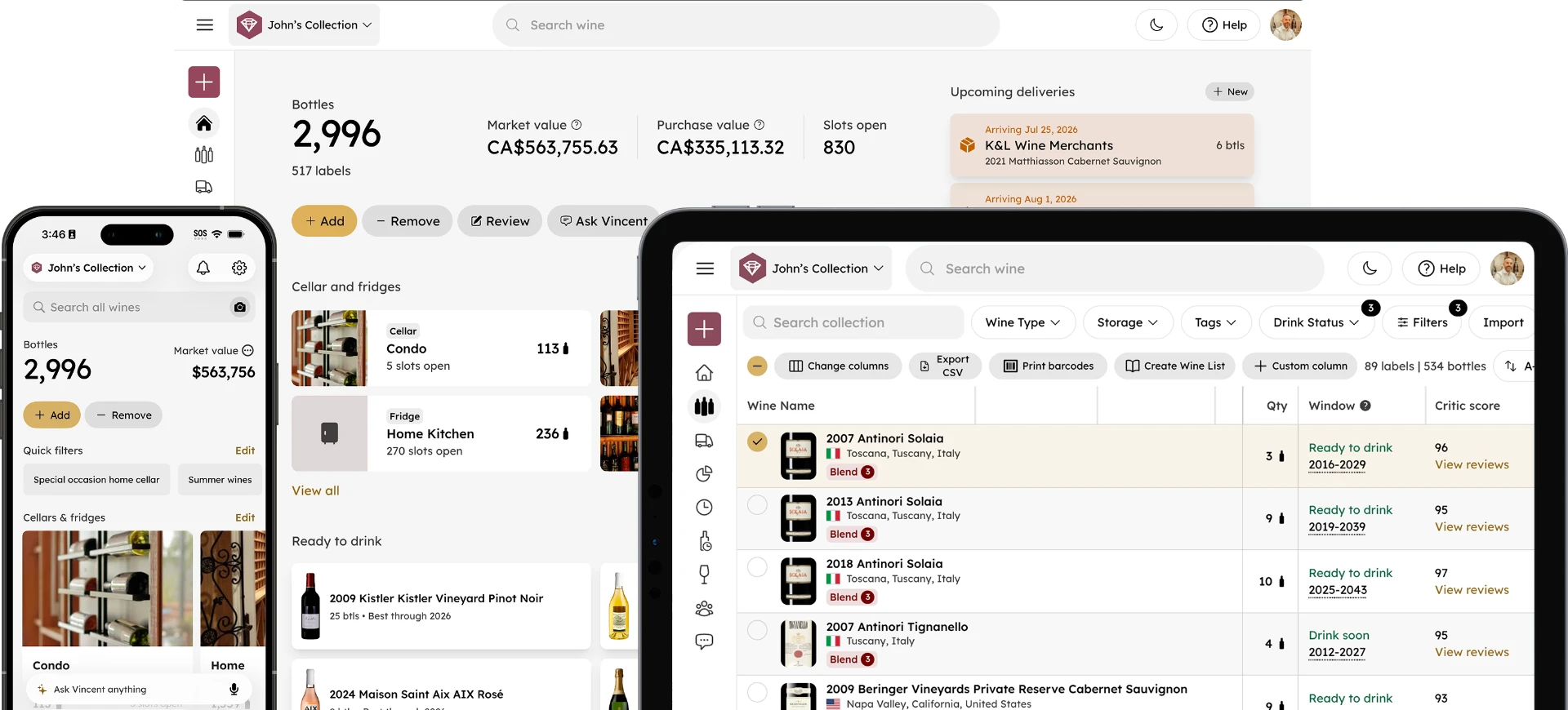
That comparison requires a per-bottle record with purchase price, current value, and holding period, which is exactly what a tracked collection provides and a spreadsheet does not. InVintory tracks market value per bottle continuously, which is what makes a benchmark comparison possible rather than theoretical.
Track your collection's value per bottle: get started in InVintory →
For collections held primarily as assets, InVintory Elite adds deeper valuation and reporting. For how automated valuation works, see our guide to tracking collection value automatically, and for formal valuation when a number needs to hold up to an insurer or a court, see our guide to getting a collection appraised.
For the broader investment picture, our guide to investing in wine is the place to start, our guide to how wine investment works covers the ownership vehicles, and our guide to which wines hold their value covers what actually drives appreciation in the first place.
This post is general information, not financial advice. Wine is an unregulated, illiquid asset. Index data describes past price movement in a defined basket and is not a prediction, a valuation of any individual holding, or a guide to what you will realize at sale.
An index is a thermometer, not a price tag. It is genuinely useful for reading the market and genuinely misleading if you mistake it for what your wine is worth.
See what your own collection is actually worth.
Compare Free, Premium and Elite →
FAQ
Is the Liv-ex 100 the best index for tracking fine wine?
It is the most widely cited benchmark and a reasonable default, but the Fine Wine 1000 and its regional sub-indices are more useful if your holdings are not concentrated in the wines the 100 covers.
How often are wine indices updated?
It varies by index. The Liv-ex Fine Wine 50 is calculated daily because its constituents trade frequently. The Fine Wine 100 and Fine Wine 1000 are calculated monthly. Publication frequency broadly reflects how liquid the underlying wines are.
Can I use an index to value my own collection?
Not directly. An index measures a defined basket of wines, and unless your holdings match that basket in composition and proportion, it describes a different portfolio than yours. Use per-bottle market valuation for your own collection and the index for market context.
Where does Liv-ex get its price data?
From transactions on its own exchange between member merchants, expressed as Liv-ex Mid Prices. This is why its data reflects trade-level pricing rather than retail asking prices.
Do wine indices include storage and transaction costs?
No. An index tracks price movement only. Storage, insurance, buyer's premium and seller's commission all sit outside it, which is a large part of why index performance and an individual collector's net outcome differ.