Wine Collection Security: Preventing Theft
Madeleine Cruickshank
September 28, 2026 · 7 min read

How do most wine collections actually get stolen from?
Most wine theft from private collections is opportunistic and comes from someone with legitimate access, a bottle at a time, rather than a break-in. This changes what actually protects a collection. A better lock on the front door does little against a risk that walks in the front door already.
That reframing matters because it points security spending at the right problem: access and accountability, not just physical barriers.
Access Control: Who Actually Has a Key
Who typically has access to a home wine cellar?
More people than most collectors realize: household staff, cleaners, contractors, caterers for events, and sometimes guests who wander during a party. Each additional person with unsupervised access is a real, if usually small, increase in risk, and the risk compounds with how long that access has existed unreviewed.
The practical fix is not distrust. It is simply knowing who has a key or a code, when it was given, and whether it still needs to exist. A key given to a contractor for a two-week project and never collected afterward is the kind of gap that goes unnoticed for years.
Should a wine cellar be locked separately from the rest of the house?
Yes, for any collection with meaningful value. A cellar with its own lock, separate from general house access, limits exposure to the smaller circle of people who actually need to be there, rather than anyone who can get into the house at all.
This is a low-cost, high-value change for most collectors, since it converts "anyone in my home could theoretically access my cellar" into a much shorter, more accountable list.
Risk During Parties and Events
Entertaining is when access control tends to break down fastest, and it is worth planning for deliberately rather than assuming it will be fine.
A house full of guests, some of whom nobody in the room actually knows well, is a different risk profile than a normal day. If you are opening the cellar itself for a tasting or a tour, consider pulling the specific bottles you plan to show in advance rather than leaving the whole room accessible, and treat the cellar door the same way you would treat a home office or a bedroom during a party: closed, not part of the tour route by default.
Catering staff and event contractors are a related, often overlooked category. They are in the home for hours, frequently unsupervised in parts of it, and their access is temporary by nature, which means it is easy to forget to plan for.
Contractor and Staff Access
How should you handle contractor access to a wine cellar?
Treat cellar access as its own decision, separate from general house access, whenever a contractor's work does not actually require being near the collection. An electrician working on a panel in another room has no reason to pass through or near the cellar, and routing them elsewhere or supervising that portion of the visit is a reasonable, ordinary precaution.
For staff with legitimate, ongoing access, whether household staff or a dedicated cellar manager, the same principle from earlier applies: know who currently has access, and review that list periodically rather than assuming it is still accurate. People change roles, leave positions, or simply no longer need the access they were once given, and the list rarely updates itself.
What Records Actually Help After a Loss
What do police and insurers actually need if wine is stolen?
A specific, itemized list: what was taken, by producer and vintage, in what quantity, and ideally supported by photographs and proof of purchase. A general statement that "some wine is missing" is close to useless for both a police report and an insurance claim, while a specific list with documentation is something both can actually act on.
This is the single biggest determinant of whether a stolen collection is ever recovered or properly compensated, and it depends entirely on records that exist before the loss, not anything that can be reconstructed afterward. See our guide to how wine provenance affects value for how the same documentation habit protects a collection's value more broadly, and our guide to getting a wine collection appraised for building a formal valuation that supports both insurance and any police report.
Does photographing bottles actually help?
Yes, meaningfully. A photograph of a bottle, especially one showing a label clearly along with any distinguishing detail, gives police and insurers something concrete to work from if a bottle surfaces at auction or through a dealer later. Rare and recognizable bottles do occasionally resurface in the secondary market, and a photograph on file is what makes that a viable recovery path rather than a coincidence nobody can act on.
Keeping an Accurate Record Before You Need One
The uncomfortable truth about wine theft is that most collectors discover a gap gradually, sometimes months after it happened, because there was no reliable way to notice a bottle was missing until they went looking for it specifically.
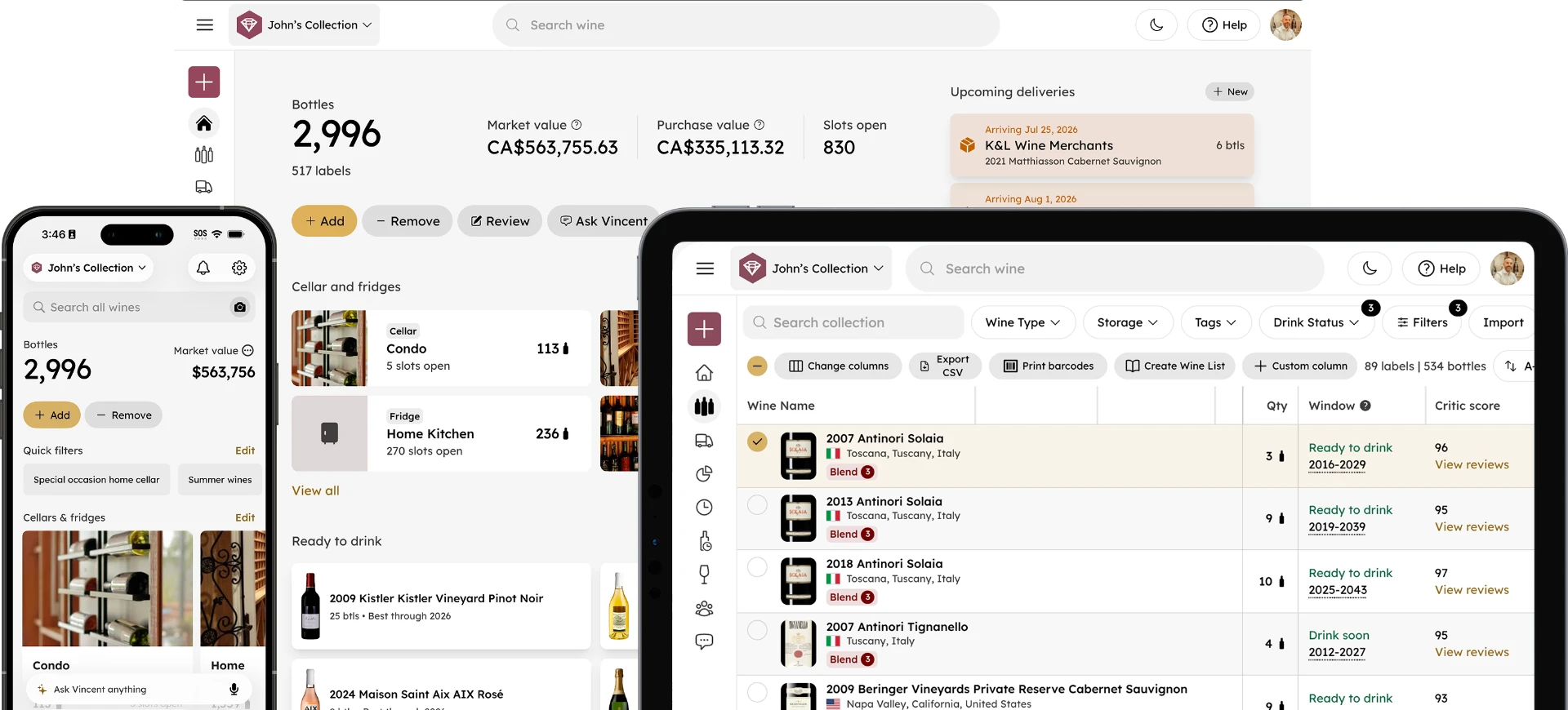
An accurate, current inventory is what closes that gap. If every bottle in your collection is logged with its location, you notice a discrepancy the next time you check the cellar rather than the next time you happen to look for that exact bottle. This is the same discipline that keeps a shared household cellar accurate; see our guide to keeping bottle locations accurate for how that habit works day to day.
Keep a record that would actually help if something went missing →
For collections large or valuable enough that a security conversation is genuinely warranted, InVintory Elite supports the deeper documentation and reporting that an insurer or, in the worst case, a police report would actually need.
What to Do in the First 24 Hours After Discovering a Loss
Move in this order: confirm what is actually missing against your own record, photograph the scene if anything looks disturbed, file a police report with the specific itemized list rather than a general description, then contact your insurer. Doing this in a different order, especially contacting insurance before you have a clear list, tends to slow the whole process down.
Do not disturb anything more than necessary before the police report is filed, on the chance there is physical evidence worth preserving. And loop in whoever manages your cellar day to day, staff, family, or a cellar manager, since they may have noticed something in the days prior that seemed unremarkable at the time but matters in hindsight.
For how this connects to the insurance side specifically, filing a claim, what documentation an insurer requires, see our guide to insuring a wine collection, which covers that process in full. This post is about prevention and the first response; that one is about what happens once a claim is actually underway.
Security for a wine collection is not really about the lock on the door. It is about knowing who has access, keeping a record accurate enough to notice when something changes, and having documentation ready before you ever need it.
Compare Free, Premium and Elite →
Frequently Asked Questions
Is homeowner's insurance enough to cover wine theft?
Usually not fully. Standard homeowner's policies often cap collectibles well below what a serious cellar is worth and can exclude wine-specific risks entirely. See our guide to insuring a wine collection for what a dedicated policy actually covers.
Should I install a camera in my wine cellar?
For a collection of meaningful value, it is a reasonable, low-friction addition, since footage is exactly the kind of specific evidence that helps both a police report and an insurance claim. It also tends to be a strong deterrent on its own once people know it is there.
How do I prove what was in my collection if I never inventoried it?
This is considerably harder after the fact. Purchase receipts, prior appraisals, and photographs help, but the honest answer is that a real inventory is something to build before a loss, not after one. Starting now still protects everything you own going forward.
Can stolen wine actually be recovered?
Sometimes, particularly rare or recognizable bottles that resurface through auction houses or dealers, but recovery depends heavily on having specific documentation, photographs, and an itemized description on file from before the loss.