InVintory Vintage Scores: Explore Regions, Subregions, and Vintages by Year
Madeleine Cruickshank
August 25, 2026 · 6 min read
Every bottle carries two stories: what's in the glass, and what happened in its region the year it was grown. InVintory's new Explore tab and Vintage Scores features are built around that second story: the weather, the conditions, and the events that made one vintage legendary and another one weak.
What are InVintory's Vintage Scores?
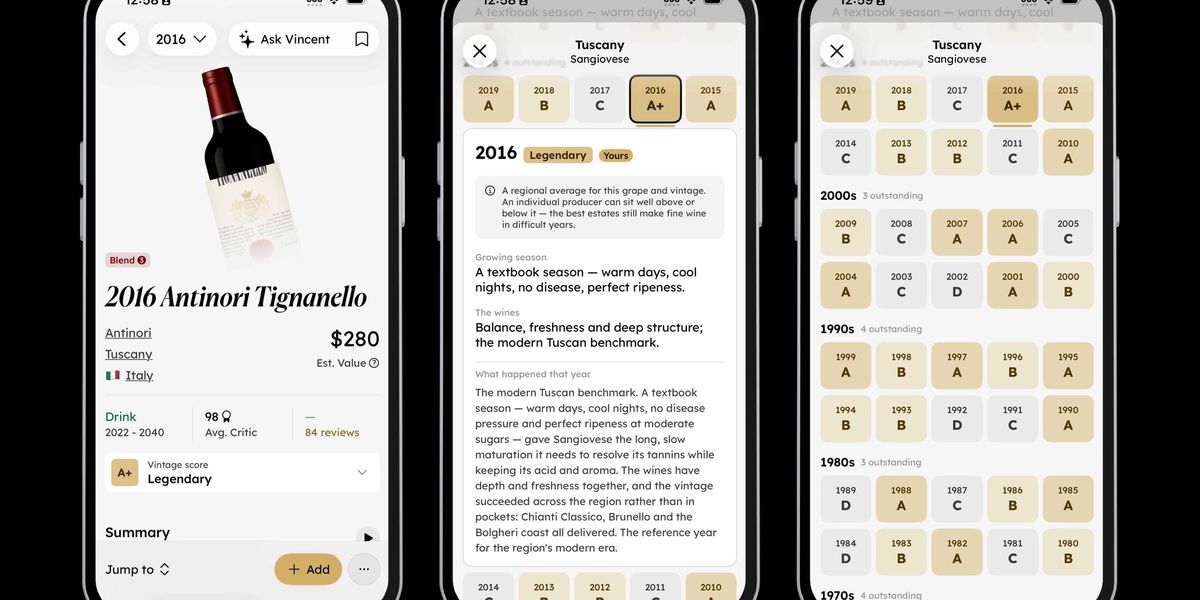
Vintage Scores are a weather-based letter grade, from D up through A and A+, describing how a specific vintage performed in a specific region, down to the subregion and grape level, built from historical weather pattern data. Rather than scoring an individual bottle the way a critic does, a Vintage Score describes the growing conditions an entire vintage experienced in that place, which is a big part of why some vintages are remembered as exceptional and others aren't.
It's worth being clear about what a Vintage Score is and isn't measuring. InVintory states this directly on the Vintage Score view itself: the grade reflects a regional average for that grape and vintage, and an individual producer can sit well above or below it, since the best estates still make fine wine even in difficult years. A strong Vintage Score is a tailwind, not a guarantee, and a weaker one doesn't rule out a genuinely excellent bottle from a producer who handled that year well.
How is a Vintage Score different from a 100-point wine score?
A 100-point score is a critic's opinion of one specific wine, tasted and judged on its own merits. A Vintage Score describes the weather and growing conditions behind an entire vintage in a specific region, which is a different, complementary signal. A wine can come from a strong vintage and still be an average bottle, or come from a weaker vintage and still overperform thanks to a skilled producer. For more on how critic scoring works, see our guide to the 100-point wine score.
The New Explore Tab
The Reviews tab has been renamed Explore, and it now does more than surface community reviews. Open it up to browse regions directly, starting with a grid of every region InVintory currently has a guide for. New region guides are being added over time, with the goal of eventually covering every wine region.
How do you browse from a region down to a specific vintage?
Tap into a region to see its subregions, tap a subregion to see the grapes grown there, and tap a grape to see how each vintage performed for that specific grape in that specific subregion. This matters because Vintage Scores genuinely vary by grape within the same subregion and year, a strong year for one variety in a given place isn't automatically a strong year for another variety grown right next to it.
This structure (region, then subregion, then grape, then vintage), is what makes it possible to actually understand a place rather than just a broad regional reputation. Two subregions within the same larger region can have meaningfully different stories in the same vintage, and two grapes within the same subregion can, too.
Within a grape's full vintage history, years are grouped by decade, each labeled with how many "outstanding" vintages that decade produced, so you can scan back through a region and grape's history and spot its strongest stretches at a glance rather than scrolling year by year.
Using Vintage Context When You're Buying, Not Just When You're Drinking
The Explore tab is just as useful before a purchase as it is after one. If you're deciding between two vintages of the same wine, or considering a bottle from a subregion you don't know well, browsing that region's story first gives you real context beyond a shelf tag or a single critic's score. A subregion that had a genuinely strong, even season for a specific grape is a more informed bet than a subregion you're simply trusting on reputation alone.
This is especially useful for regions and vintages you haven't tasted your way through personally yet, where a critic score might exist for one specific bottle, but the broader vintage story tells you something a single score can't: whether the conditions that year were kind to that specific grape in that specific place, or whether a particular bottle is more of an exception than the rule.
Vintage Scores on the Wine Guide
A new Vintage Score section now sits near the top of the Wine Guide for any bottle you're looking at, showing that bottle's specific vintage grade and the story behind it, whether that's an ideal growing season or a specific setback like a heat spike, frost, or wildfire smoke exposure. From there, tap through to explore that region more broadly, the same Explore tab experience, just entered from the bottle you're already looking at rather than browsing from scratch.
The Five Vintage Score Grades
Each Vintage Score grade carries a plain-language label, so you're not left guessing what a letter actually means. Using Tuscany Sangiovese as a real example across all five grades:
A+, Legendary
The benchmark years, where growing conditions came together with almost no flaws. 2016 in Tuscany is an example: "a textbook season, warm days, cool nights, no disease, perfect ripeness," producing wines with "balance, freshness and deep structure," described as the modern Tuscan benchmark.
A, Excellent
A strong, generous vintage just a step below legendary. 2015 in Tuscany was "warm and dry with cool nights preserving aromatics," producing wines that were "ripe, generous and powerful; broadly excellent and approachable."
B, Good
A solid, pleasant vintage without the depth of a top year, often drinking well earlier rather than needing extended aging. 2018 in Tuscany had "a wet spring and mild summer with no heat extremes," producing wines that were "fresh and mid-weight; earlier-drinking and pleasantly classical."
C, Average
A mixed or challenging season that still produced usable, if unremarkable, wine. 2003 in Tuscany dealt with "the August heatwave with severe drought," producing wines described as "baked and low-acid; already tiring."
D, Weak
A genuinely difficult vintage, usually tied to a specific, damaging event during the growing season. 2002 in Tuscany saw "persistent rain and hail through the harvest," producing wines InVintory describes plainly as "dilute and poor; widely declassified. Avoid."
These grades and their example narratives are regional averages for a specific grape, not a verdict on every bottle from that year, which is exactly what the disclaimer above is getting at. A skilled producer in a D year can still turn out a wine worth drinking; an average producer in an A+ year won't automatically outperform them.
Why does knowing the vintage story actually matter?
Understanding what a vintage went through helps you both buy and drink more intentionally. A vintage known for heat stress in a given region might mean bottles built for shorter aging even if the label alone doesn't tell you that, while a vintage known for a long, cool, even season might reward more patience in the cellar. This context adds real depth beyond just the number on a critic's scorecard.
Where This Connects to the Rest of Your Collection
Vintage Scores work alongside everything else InVintory already tracks. If you're deciding how long to hold a bottle, the vintage's growing conditions are a genuine input alongside the grape-specific guidance in our varietal guides, like our Cabernet Sauvignon guide or our guide to red wine varieties. If a vintage's story mentions heat stress or environmental damage specifically, it's worth cross-referencing with our guide to wine faults to understand what that kind of stress can actually do to a finished wine.
Explore your bottles' vintage stories now: open the Explore tab in InVintory →
If you're building out tasting notes and want a place to record what you actually thought once you know the vintage's backstory, see Wine Reviews, Revamped for the full rundown of InVintory's tasting note and scoring tools.
A number on a label tells you very little on its own. Knowing the actual growing season behind that number is what turns a bottle into a story worth understanding before you open it.
See the weather story behind every bottle in your cellar.
FAQ
Do Vintage Scores apply to every wine region?
Region guides are being added over time, with the goal of eventually covering every region. Check the Explore tab's region grid for what's currently available.
Can two grapes in the same subregion have different Vintage Scores in the same year?
Yes. Vintage Scores vary by grape within a subregion, since different varieties respond differently to the same growing season's conditions.
Is a Vintage Score the same thing as a critic's rating for that year?
No. On a bottle's Wine Guide, the Vintage Score appears as its own field, separate from the average critic score and the drink window, since each reflects something different: the Vintage Score is the regional weather story for that year, the critic score is a taster's judgment of a specific wine, and the drink window is when that bottle is likely at its best. They're related but distinct signals, and InVintory shows all three side by side rather than blending them into one number.
Where do I find the Vintage Score for a bottle I already own?
Open that bottle's Wine Guide and look for the Vintage Score section near the top, then tap through to explore the full region if you want more context.