Types of Red Wine: 12 Popular Reds Explained
Madeleine Cruickshank
October 16, 2025 · 10 min read
What are the most popular types of red wine?
There are 12 red wine varieties that make up the overwhelming majority of what is grown, sold, and cellared worldwide, and Cabernet Sauvignon is the most planted and most collected of them. Red wine differs from white in one respect that explains almost everything else about it: the grape skins stay in contact with the juice during fermentation, which is where color, tannin, and aging capacity all come from.
That single production difference is why reds are structured enough to cellar for years and whites, with a handful of exceptions, are not.
The 12 Red Wines at a Glance
Cabernet Sauvignon. Full body, high tannin. Bordeaux, Napa Valley, Coonawarra. Drinks 10 to 20 years.
Merlot. Medium to full body, medium tannin. Right Bank Bordeaux, Napa, Chile. Drinks 5 to 15 years.
Pinot Noir. Light to medium body, low tannin. Burgundy, Oregon, Central Otago. Drinks 5 to 15 years.
Syrah and Shiraz. Full body, medium to high tannin. Northern Rhone, Barossa Valley. Drinks 8 to 20 years.
Malbec. Full body, medium tannin. Mendoza, Cahors. Drinks 5 to 10 years.
Zinfandel. Full body, medium tannin. California, primarily Sonoma and Lodi. Drinks 3 to 8 years.
Sangiovese. Medium body, high tannin and high acid. Tuscany. Drinks 5 to 15 years, longer for Brunello and Riserva.
Tempranillo. Medium to full body, medium tannin. Rioja, Ribera del Duero. Drinks 5 to 20 years by classification.
Grenache. Medium to full body, low to medium tannin. Southern Rhone, Priorat, Sardinia. Drinks 3 to 10 years.
Nebbiolo. Full body, very high tannin, pale color. Piedmont. Drinks 10 to 25 years.
Barbera. Medium body, low tannin, high acid. Piedmont. Drinks 2 to 8 years.
Gamay. Light body, low tannin. Beaujolais. Drinks 1 to 5 years, longer for Cru Beaujolais.
Body and tannin are the two attributes that determine how a red tastes in the glass and how long it will hold in a cellar. For the full explanation of what those terms actually mean and how to use them when buying, see how red wine body works.
The 12 Red Wine Varieties Explained
Cabernet Sauvignon
Cabernet Sauvignon is a full-bodied red from Bordeaux and Napa that typically rewards 10 to 20 years of cellaring. It is the most widely planted red grape in the world and the backbone of most serious collections.
Thick skins give it high tannin and deep color, which is exactly what allows it to age for decades. Expect blackcurrant, cedar, graphite, and often a distinct herbal note. Young Cabernet is firm and can feel austere; the tannin resolves with time into something considerably more generous.
Left Bank Bordeaux blends it with Merlot and Cabernet Franc and ages longest. Napa tends to be riper, more approachable younger, and fruit-forward. Coonawarra in Australia produces a distinctive eucalyptus-inflected style on its terra rossa soil. For the full varietal treatment, see our complete Cabernet Sauvignon collector's guide.
Merlot
Merlot is a medium to full-bodied red that drinks well from 5 to 15 years and is considerably more approachable young than Cabernet Sauvignon. It is the most planted grape in Bordeaux, despite Cabernet's greater fame.
Softer tannins and plummier fruit make it the friendlier of the two Bordeaux mainstays. Expect plum, black cherry, chocolate, and a rounder mouthfeel. Right Bank Bordeaux, particularly Pomerol and Saint-Emilion, produces the most serious and longest-lived examples, some of which rival first-growth Cabernet in price and longevity.
It is also the most commonly blended red in the world, which is why plenty of people who think they dislike Merlot have been drinking it inside other wines for years. For the full varietal treatment, see our complete Merlot collector's guide.
Pinot Noir
Pinot Noir is a light to medium-bodied red with low tannin and high acidity that typically drinks well from 5 to 15 years. It is the most difficult major grape to grow and the one that rewards site specificity most dramatically.
Thin skins mean pale color and delicate structure. Expect red cherry, raspberry, forest floor, and with age a distinctly savory, mushroomy complexity. Burgundy is the benchmark and the most expensive wine region on earth by the bottle; Oregon, Sonoma Coast, and Central Otago all produce serious examples.
Because it is light-bodied, Pinot Noir benefits from a slight chill in warm weather, which is unusual among reds. See our complete Pinot Noir collector's guide.
Syrah and Shiraz
Syrah and Shiraz are the same grape under two names, producing a full-bodied red that typically drinks from 8 to 20 years, with the name signaling the style. Syrah generally indicates a more restrained, savory European expression; Shiraz signals a riper, bolder Australian one.
Northern Rhone Syrah, from Hermitage and Cote-Rotie, is peppery, meaty, and structured. Barossa and McLaren Vale Shiraz is richer, sweeter-fruited, and often higher in alcohol. Both age well, and the black pepper note that runs through the variety is one of the most identifiable markers in all of wine.
Malbec
Malbec is a full-bodied red with medium tannin that typically drinks from 5 to 10 years, and Argentina has made it its own. Originally a minor Bordeaux blending grape, it found its defining expression in the high-altitude vineyards of Mendoza.
Expect dark plum, blackberry, violet, and a characteristically soft, plush texture that makes it unusually approachable for a full-bodied wine. Cahors in southwest France produces a firmer, more rustic version under the local name Cot.
Zinfandel
Zinfandel is a full-bodied, high-alcohol red that generally drinks best within 3 to 8 years, making it one of the shorter-lived reds on this list. It is genetically identical to Italy's Primitivo.
Expect jammy blackberry, black pepper, and often noticeable sweetness from ripeness rather than residual sugar. Old-vine Sonoma and Lodi Zinfandel from vines planted a century ago produces concentrated, characterful wine that is among California's most distinctive contributions. Note that white Zinfandel, the pale sweet rose, is made from the same grape and bears no resemblance to the red wine.
Sangiovese
Sangiovese is a medium-bodied red with high tannin and high acidity that drinks from 5 to 15 years, and considerably longer for Brunello di Montalcino and Riserva bottlings. It is the grape of Tuscany and the backbone of Chianti.
Expect sour cherry, dried herbs, tomato leaf, and a savory edge that makes it one of the most food-friendly reds in existence. Its acidity is the reason it works so well against Italian food. Quality varies enormously by designation: Chianti Classico, Brunello di Montalcino, and Vino Nobile di Montepulciano are the serious expressions, while basic Chianti is a different proposition entirely.
Tempranillo
Tempranillo is a medium to full-bodied Spanish red whose drinking window ranges from 5 to 20 years depending almost entirely on its aging classification. It is the principal grape of both Rioja and Ribera del Duero.
Spanish labeling does most of the work here. Crianza sees modest oak and drinks young; Reserva more; Gran Reserva spends years in barrel and bottle before release and can age for decades. Expect red cherry, leather, dried fig, and, in traditional Rioja, a pronounced vanilla and coconut character from American oak.
Grenache
Grenache is a medium to full-bodied red with low to medium tannin that typically drinks from 3 to 10 years and is most often found in blends. It is the dominant grape in Chateauneuf-du-Pape and a cornerstone of the GSM blend with Syrah and Mourvedre.
Expect red fruit, white pepper, dried herbs, and noticeably high alcohol, since Grenache accumulates sugar readily in warm climates. Old-vine Priorat in Catalonia and single-varietal Sardinian Cannonau show what it can do on its own.
Nebbiolo
Nebbiolo is a full-bodied red with the highest tannin of any grape on this list, deceptively pale in color, that typically needs 10 to 25 years to fully resolve. It produces Barolo and Barbaresco in Piedmont.
The color misleads people constantly. Nebbiolo looks like Pinot Noir in the glass and behaves like nothing else, with grip and acidity that can be genuinely punishing in youth. Expect tar, roses, sour cherry, and with real age a haunting, dried-floral complexity that explains why collectors are willing to wait. Subregion matters too: Barolo from La Morra is typically more approachable than Serralunga d'Alba, despite the same grape and the same appellation.
Barbera
Barbera is a medium-bodied Piedmontese red with unusually low tannin and very high acidity that generally drinks well from 2 to 8 years. It is Nebbiolo's everyday counterpart in the same region.
Expect bright red cherry, plum, and a fresh, juicy character with very little grip. The low tannin and high acid combination makes it one of the most versatile food wines and one of the easiest reds to drink young. Barbera d'Asti and Barbera d'Alba are the main appellations.
Gamay
Gamay is a light-bodied, low-tannin red that typically drinks from 1 to 5 years, and up to 10 for the best Cru Beaujolais. It is the grape of Beaujolais and the most reliably chillable red in wide circulation.
Expect red berry, banana and bubblegum notes in carbonic-macerated styles, and genuine mineral structure in the ten Crus, particularly Morgon, Moulin-a-Vent, and Fleurie. Beaujolais Nouveau, released weeks after harvest, is the mass-market version and not representative of what the grape can do. For how to serve Gamay and other light reds in warm weather, see our guide to enjoying red wine in summer.
Which Red Wines Age Best?
The reds that age longest are the ones with the most tannin and acid, which on this list means Nebbiolo, Cabernet Sauvignon, Syrah, and top-tier Sangiovese and Tempranillo. Tannin and acid are preservatives, and a wine without much of either has nothing to carry it through a decade.
That is why Gamay and Barbera are delicious young and largely finished within a few years, while Barolo can be difficult at ten and magnificent at twenty five. Alcohol, fruit concentration, and how the wine was made all matter too, but tannin and acid are the structural prerequisites.
Serving Red Wine
Most red wine is served too warm. The range is roughly 55F to 65F, with lighter reds like Gamay, Barbera, and Pinot Noir at the cooler end and full-bodied Cabernet, Syrah, and Nebbiolo at the warmer. Room temperature in a modern heated house is several degrees above what any red wants.
Young, tannic reds benefit most from decanting, typically 30 minutes to two hours. Older reds with sediment need decanting for separation rather than aeration, and much less time in the decanter. For exact temperatures by style, see our wine serving temperature guide, and for decanting specifics, see our complete decanting guide.
Tracking Red Wines in Your Collection
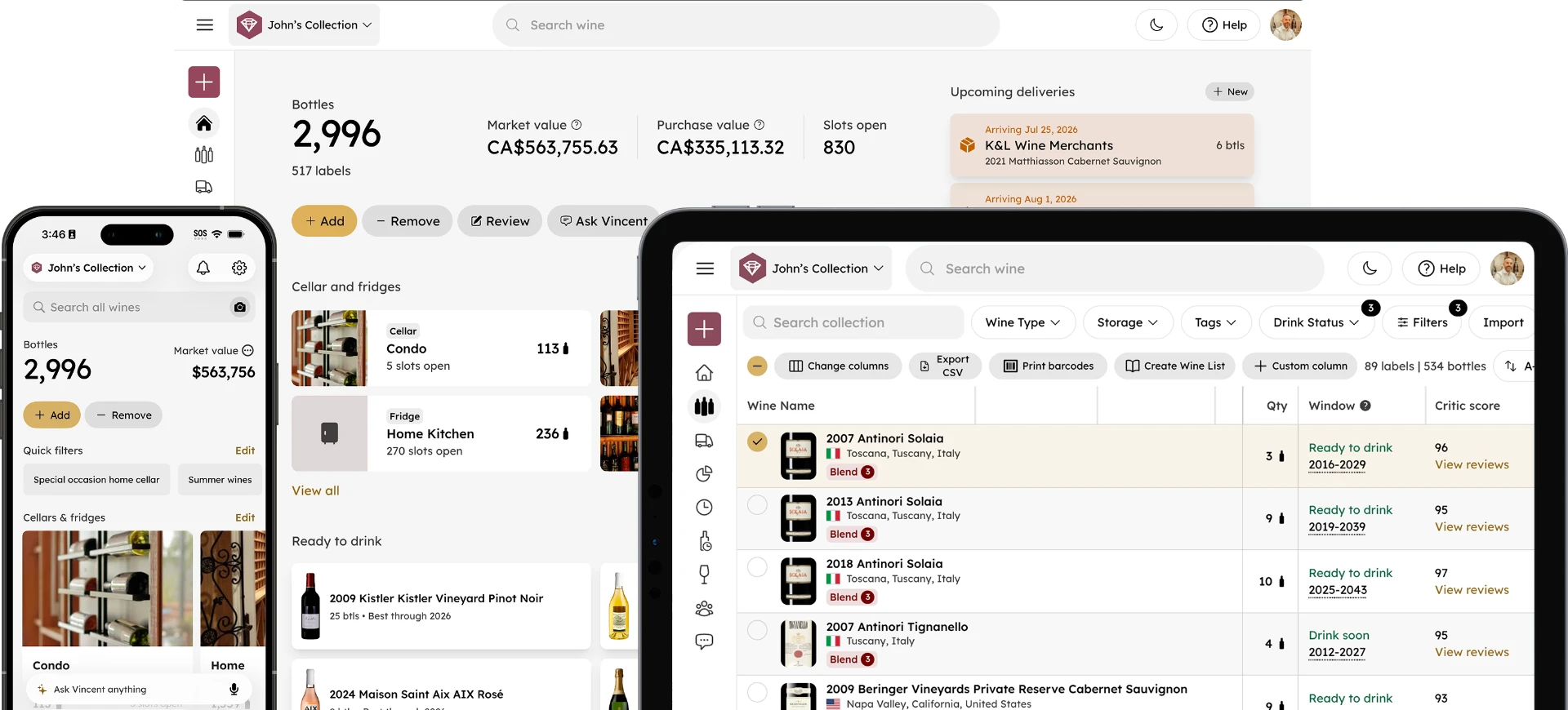
The practical problem with collecting across 12 varieties is that each has a different drinking window, and no one remembers 200 of them. Cabernet bought in the same year as Gamay needs a completely different plan.
InVintory holds a drink window against every bottle, so what is ready surfaces on its own rather than being something you reconstruct from memory. It also tracks market value per bottle, vintage scores by region and grape, and exactly where each bottle sits in your storage through VinLocate.
Track drink windows across every variety in your cellar →
For a deeper look at how organizing by variety, region, or drinking window actually works in practice, see our guide to organizing a wine collection.
Twelve varieties is enough to build a complete cellar and more than enough to drink well for a lifetime. The differences between them are structural rather than cosmetic, and once body and tannin make sense, everything else about red wine follows.
Frequently Asked Questions
What is the most popular red wine?
Cabernet Sauvignon is the most widely planted and most collected red wine variety worldwide, followed closely by Merlot, which is the most planted grape in Bordeaux specifically.
Which red wine is easiest to drink for a beginner?
Merlot, Malbec, and Gamay are the most approachable, because all three have soft tannins and forward fruit. Nebbiolo and young Cabernet Sauvignon are the hardest, since high tannin reads as astringent until it has had time to resolve.
What is the difference between Syrah and Shiraz?
They are the same grape. Syrah generally signals a more restrained, savory European style from the Northern Rhone, and Shiraz signals a riper, fuller Australian one. The name on the label is a style indicator rather than a botanical distinction.
Which red should I open tonight?
That depends on what you are eating and what is actually ready to drink in your cellar. Vincent, InVintory's AI sommelier, answers this from your own collection rather than from a generic pairing chart. Ask Vincent what to open →
How long can you age red wine?
It varies by variety from about 2 years for Barbera to 25 years or more for Nebbiolo and top Cabernet Sauvignon. Tannin and acidity are what determine aging capacity, so the more structured the wine, the longer it will hold.
Are all red wines dry?
Almost all still red wine is dry. Sweet reds exist, including Port, Recioto della Valpolicella, and some commercial sweet red blends, but they are the exception rather than the rule across the 12 varieties above.