Riesling Sweetness Tiers: A Collector's Guide
Martine McLarney
October 13, 2026 · 5 min read
Riesling has the widest range of any major white grape, and that range is exactly what confuses people. The same variety produces a bone-dry Alsatian bottle and an intensely sweet German dessert wine, and both are correct. Germany's Pradikat system exists to tell you which one you're holding before you open it. This guide covers how that system works tier by tier, how long each tier ages, how to serve them, and how to track drink windows across a mixed Riesling collection. For where Riesling sits among other whites, see our guide to white wine varieties.
Is Riesling sweet or dry?
Riesling ranges from bone dry to intensely sweet, and the label tells you which. Unlike most grapes, where sweetness is mostly a producer's stylistic choice, German Riesling in particular uses a formal system, the Pradikat, that classifies wine by how ripe the grapes were at harvest. Riper grapes generally mean more residual sugar, though many producers also make fully dry versions at every Pradikat level, so the tier name alone doesn't guarantee a sweet wine. Producers in Germany increasingly print "trocken" (dry) or "feinherb" (off-dry) directly on the label alongside the Pradikat tier specifically to resolve this ambiguity. Reading the label in full, not guessing from the grape or the tier name alone, is the only reliable way to know what's actually in the bottle.
German Pradikat tiers explained
The Pradikat system ranks Riesling by ripeness at harvest, from lightest to most concentrated. Sugar and drink window both climb as you move up the scale, and each tier requires a progressively later, more selective harvest, which is part of why the top tiers are also the rarest and most expensive.
Kabinett: The lightest tier, made from the earliest-picked, least ripe grapes. Usually the driest or lowest in residual sugar of the six, though some producers make it slightly off-dry. Peaks within five to fifteen years of the vintage.
Spatlese ("late harvest"): Riper grapes picked later than Kabinett, with noticeably more concentration. Made both dry and off-dry depending on the producer. Develops well for ten to twenty years.
Auslese ("select harvest"): Made from selectively harvested, very ripe bunches, sometimes with early botrytis. Usually sweeter and richer than Spatlese. Rewards fifteen to twenty-five years in a strong vintage.
Beerenauslese ("berry select harvest"): Individual berries are hand-selected, typically affected by noble rot, which concentrates sugar dramatically. An intensely sweet dessert wine. Can age for twenty to forty years or longer.
Eiswein ("ice wine"): Grapes are left on the vine and harvested frozen, which concentrates sugar and acid without requiring botrytis. Intensely sweet with piercing acidity. Ages on a similar timeline to Beerenauslese, often twenty to forty years.
Trockenbeerenauslese (TBA): The highest tier, made from individually selected, shriveled, botrytis-affected berries that look almost raisined. Yields are tiny, sometimes a handful of bottles per vine, which is part of why genuine TBA is both rare and expensive. Extremely concentrated in sugar and flavor. The longest-lived of all six tiers, with real examples still developing after fifty years.
How Riesling ages by tier
Riesling ages differently than most white wine because two natural preservatives work together across the Pradikat scale: high acidity at every tier, and increasing residual sugar as the tier climbs. That combination is why a well-stored Auslese or Beerenauslese can hold and improve for decades when an equivalently priced Chardonnay would already be past its best. As dry and lightly off-dry tiers like Kabinett age, they develop the variety's signature petrol note alongside honey and dried fruit. Sweeter tiers develop further toward marmalade, dried apricot, and honeycomb, with the sugar keeping pace against the wine's naturally high acid for years longer than most white wine styles can manage. This is also why vintage matters more for Riesling than for many other whites: a warm, ripe vintage across Germany or Alsace can push an entire year's Kabinett closer to what a typical Spatlese tastes like, so the tier name is a starting point rather than a fixed guarantee. Our guide on when a wine is ready to drink covers how to judge that window across a mixed collection, not just Riesling.
Serving Riesling
Dry and off-dry tiers, Kabinett and most Spatlese, serve like other light aromatic whites, 45 to 50°F. The sweeter dessert tiers, Beerenauslese, Eiswein, and Trockenbeerenauslese, do best colder still, closer to 42 to 45°F, cold enough to balance the concentrated sugar without tasting flat. Our wine serving temperature guide breaks down the full range for other white wine styles.
Tracking Riesling in InVintory
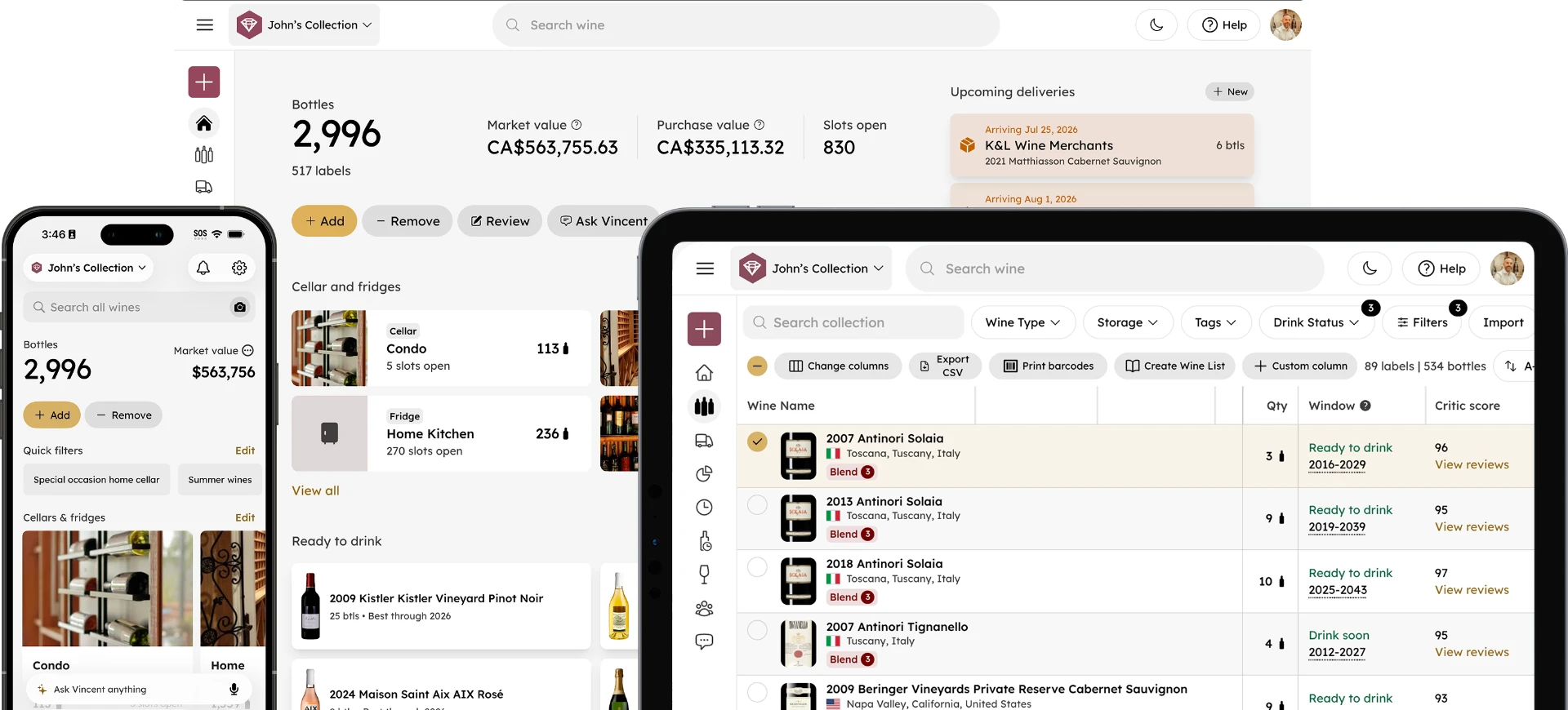
A Riesling collection spread across six Pradikat tiers is exactly the kind of thing that gets confusing without a system. InVintory's Wine Guide records a bottle's acidity and structure right on its profile page, so you're not relying on memory to recall whether a specific bottle was a dry Kabinett or a sweeter Spatlese when you're deciding what to open. If you tell Vincent, InVintory's AI wine assistant, that you lean toward off-dry or dessert-style Riesling, he remembers that preference and factors it into future recommendations instead of starting from scratch every time you ask.
Try InVintory free and start logging your Riesling collection by tier from the first bottle.
Riesling rewards knowing which tier is actually in your glass. Get that right, and the sweetness, the serving temperature, and the aging window all fall into place on their own.
See what's included in Premium and Elite, where full drink-window tracking and Vincent's memory of your preferences live.
Frequently Asked Questions
Does Riesling need to age, or can you drink it young?
Both work, depending on the tier. Kabinett and most Spatlese are enjoyable young and don't require aging, while Auslese and the sweeter tiers genuinely improve with a decade or more in the bottle. There's no rule that Riesling must be aged, only that the higher tiers reward it more than most white wine.
What causes the "petrol" aroma in aged Riesling?
It comes from a naturally occurring compound called TDN that develops as Riesling ages, more so in warmer vintages and with bottle age. It's considered a hallmark of well-aged Riesling rather than a flaw, though how much a taster enjoys it is a matter of personal preference.
What food pairs well with Riesling?
Dry Riesling's high acidity makes it excellent with spicy food, especially Thai and Vietnamese dishes, along with pork and oysters. Sweeter tiers like Beerenauslese and Trockenbeerenauslese pair well with foie gras, blue cheese, or fruit-based desserts, where the wine's sugar and acid can stand up to equally intense flavors.
Is German Riesling better than Riesling from other countries?
Not necessarily, just more formally classified. Alsace, Austria, Australia's Clare and Eden Valleys, New York's Finger Lakes, and Washington State all produce excellent Riesling in a range of sweetness levels, they simply don't use Germany's Pradikat system to label it, so the sweetness level is usually stated on the back label instead.
Log your first bottle in InVintory and see how quickly tracking Riesling by tier makes sense of a mixed collection.