When Is a Wine Ready to Drink? Peak Timing Guide
Madeleine Cruickshank
August 6, 2026 · 6 min read
How do you know when a wine is ready to drink?
A wine is ready when its tannins have softened and its fruit, acidity, and secondary aromas are in balance, which for most everyday wines is within three to five years of the vintage. Beyond that general window, a few concrete signs help: the color has shifted slightly at the rim (reds turning brick or garnet, whites deepening toward gold), the tannins no longer feel harsh or drying, and the wine shows aromas beyond straightforward fruit, like earth, leather, or dried flowers, alongside what's still there from the fruit itself.
Signs a Wine Is Past Its Prime
A wine that's gone past its peak, rather than simply being ready, usually shows different signals. Fruit character fades and flattens rather than integrating with other aromas. Color continues shifting toward brown at the edges well beyond the normal maturity range for that wine's style. And the wine can taste thin or hollow in the middle, having lost the structure that made it interesting when younger. None of these signs mean a wine is undrinkable, but they do mean it's no longer showing what it was capable of at its best.
How Long Can You Age Different Wines?
Aging potential varies enormously by grape, style, and region, and no single rule applies across all of them.
Light, aromatic whites (Sauvignon Blanc, Pinot Grigio, most rosé) are generally best within one to two years of the vintage, since their appeal is fresh fruit and acidity that fades relatively quickly.
Unoaked Chardonnay typically drinks best within two to three years, while oaked Chardonnay and white Burgundy can develop well for five to ten years, sometimes longer for top producers.
Riesling is a notable exception among whites, since its high acidity lets many styles age gracefully for ten to twenty years or more, developing complex petrol and honeyed notes over time.
Sparkling wine, non-vintage Champagne and most Prosecco or Cava, is generally best within two to three years, while vintage Champagne from a strong year can develop well for a decade or longer.
Lighter reds (Gamay, most Beaujolais, lighter Pinot Noir) are typically at their best within one to five years, though top Cru Beaujolais and serious Burgundy can age considerably longer.
Cabernet Sauvignon and Merlot from established producers generally need five to fifteen years, varying by region and structure. For a deeper look at Cabernet specifically, see our Cabernet Sauvignon guide.
Syrah and Shiraz typically fall in a five-to-twelve-year window, depending on region and ripeness style.
Sangiovese and Chianti generally need five to ten years, with Riserva bottlings built for longer aging.
Nebbiolo (Barolo and Barbaresco) is among the longest-lived common styles, often needing ten to twenty years or more before its notoriously firm tannin fully resolves.
Why Region Matters Alongside Grape
The grape ranges above are a starting point, not the full picture, since the same grape from different regions or climates can age quite differently. A warmer-climate Cabernet, riper and more approachable young, often reaches its window sooner than a cooler-climate, more structured example of the same grape. A producer's winemaking style, riper and fruit-forward versus more traditional and tannic, shifts the timeline too. Two bottles of the same variety, same vintage, from different producers, can genuinely call for different treatment in your cellar rather than one blanket rule.
This is part of why tracking drink windows at the level of the specific bottle, rather than applying one rule per grape, gives a more accurate picture than general guidelines alone ever can.
Does Storage Affect When a Wine Is Ready?
Yes, meaningfully. A wine stored at unstable or excessive temperatures ages faster and less predictably than one held in stable, cool conditions, which means the same bottle can hit its peak earlier, or develop flaws, if it hasn't been properly cared for. This is part of why two bottles of the same wine can genuinely taste different at the same age, depending entirely on how each one was stored. For the full picture on getting storage conditions right, see our wine storage temperature guide.
Can an App Tell Me When to Drink a Bottle?
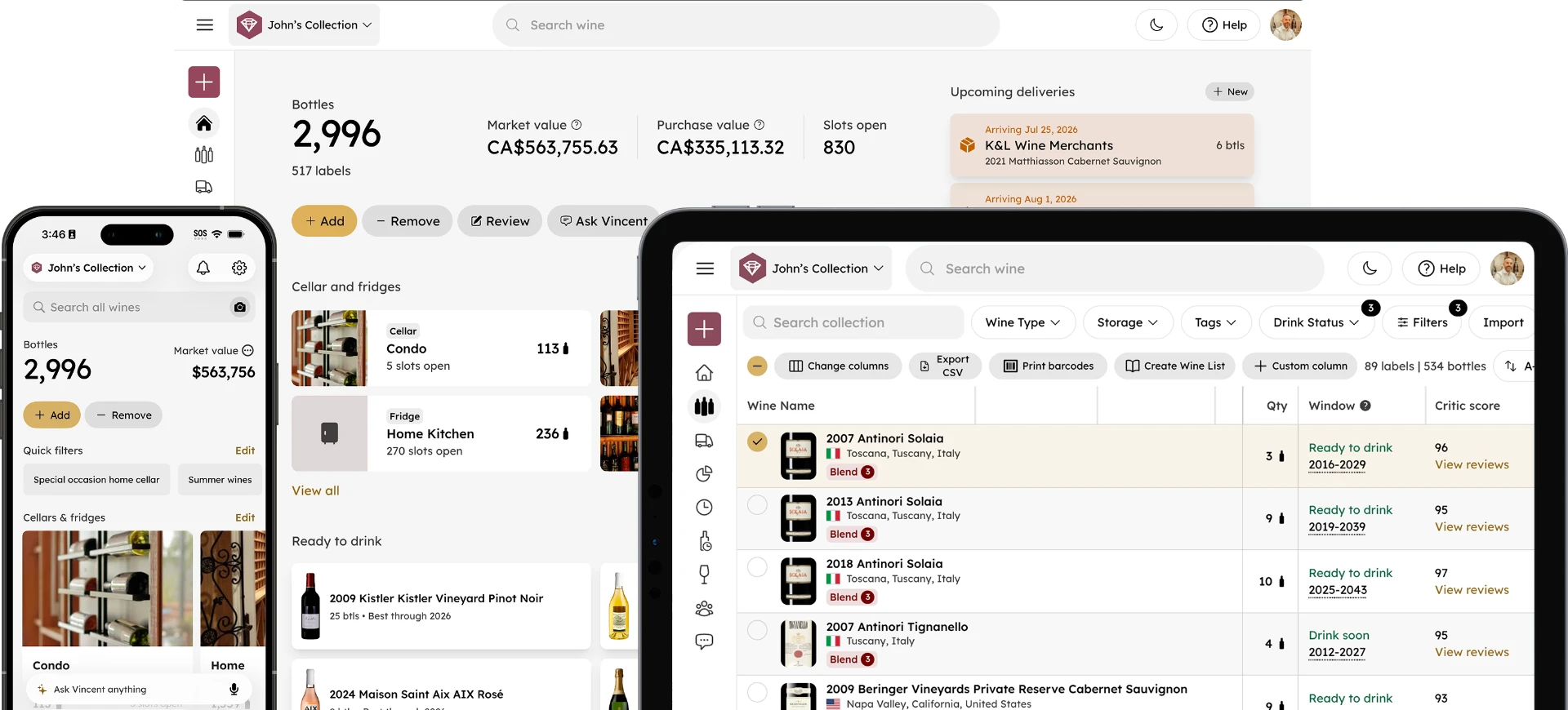
Yes. InVintory calculates an ideal drinking window for each bottle in your collection automatically and surfaces what's currently ready to drink, so you're not relying on general rules of thumb or memory to catch a bottle at its peak. Ask Vincent, InVintory's AI wine assistant, what's ready to drink tonight, and it answers from your actual collection rather than generic guidance that assumes a bottle you don't own.
See what's ready to drink in your own cellar: ask Vincent →
If you're unsure where a specific bottle in your own collection falls, checking its calculated window rather than guessing from the grape alone is the more reliable approach, especially for anything you're holding for a meaningful stretch of time.
Deciding What to Do Once a Wine Is Ready
Knowing a wine is at its peak is a different question from deciding whether to drink it now, hold it longer, or sell it, and that decision depends on factors beyond just maturity, including your own plans for the bottle and its current market value. For that fuller decision framework, see our guide on when to drink, sell, or hold, and for more on how InVintory's Ready to Drink feature works day to day, see our feature walkthrough.
A drinking window is a range, not a single deadline, and the goal is catching a wine somewhere inside it, not hitting an exact date.
Never guess at a bottle's peak window again.
FAQ
What happens if I drink a wine before its window opens?
It won't be flawed, but it may taste tighter, more tannic, or less complex than it would at full maturity. Young wines aren't damaged by early drinking, they simply haven't finished developing yet.
Can a wine still be good after its drinking window closes?
Sometimes, though it's a matter of personal preference at that point. Some drinkers enjoy the more tertiary, earthy character of an older wine even past what's considered its technical peak, while others prefer to catch it earlier.
Do white wines have shorter drinking windows than reds?
Generally, yes, with notable exceptions like Riesling and top white Burgundy. Most white wines rely on fresh fruit and acidity that fade faster than the tannin structure that lets many reds age longer.
How accurate are app-calculated drinking windows?
They're a well-informed estimate based on grape, region, vintage, and general aging patterns, not a guarantee for every individual bottle, since storage history and personal taste both affect when a specific bottle actually tastes best to you.