Spreadsheet vs Wine App: Why Collectors Are Switching
Madeleine Cruickshank
January 12, 2026 · 4 min read

Is a spreadsheet enough for tracking a wine collection?
A spreadsheet can log what you own, but it can't tell you where a bottle physically sits, when it's ready to drink, or what your collection is currently worth. A dedicated wine app automates all three, which is why collectors moving past a few dozen bottles tend to outgrow spreadsheets specifically at the point where those three questions start mattering.
What a Spreadsheet Actually Does Well
Spreadsheets are flexible, familiar, and free. For a small collection, tracked casually, a simple list of producer, vintage, and quantity is genuinely enough. The limitations show up as the collection grows and as you start wanting answers a static list can't give you.
Where Spreadsheets Break Down
They don't know where a bottle is
A spreadsheet can note "Rack 3" in a text field, but it can't show you a visual map, and that field goes stale the moment you move a bottle without updating it.
They don't track drink windows
Knowing a wine is "ready" requires you to research and remember it yourself, for every bottle, on an ongoing basis.
They don't value your collection
Market prices shift constantly. A spreadsheet shows whatever number you last typed in, which is usually out of date within months.
They require constant manual upkeep
Every purchase, every consumed bottle, every location change needs a manual update, and the sheet is only as accurate as your discipline in making those updates.
What a Wine App Adds
Visual location mapping
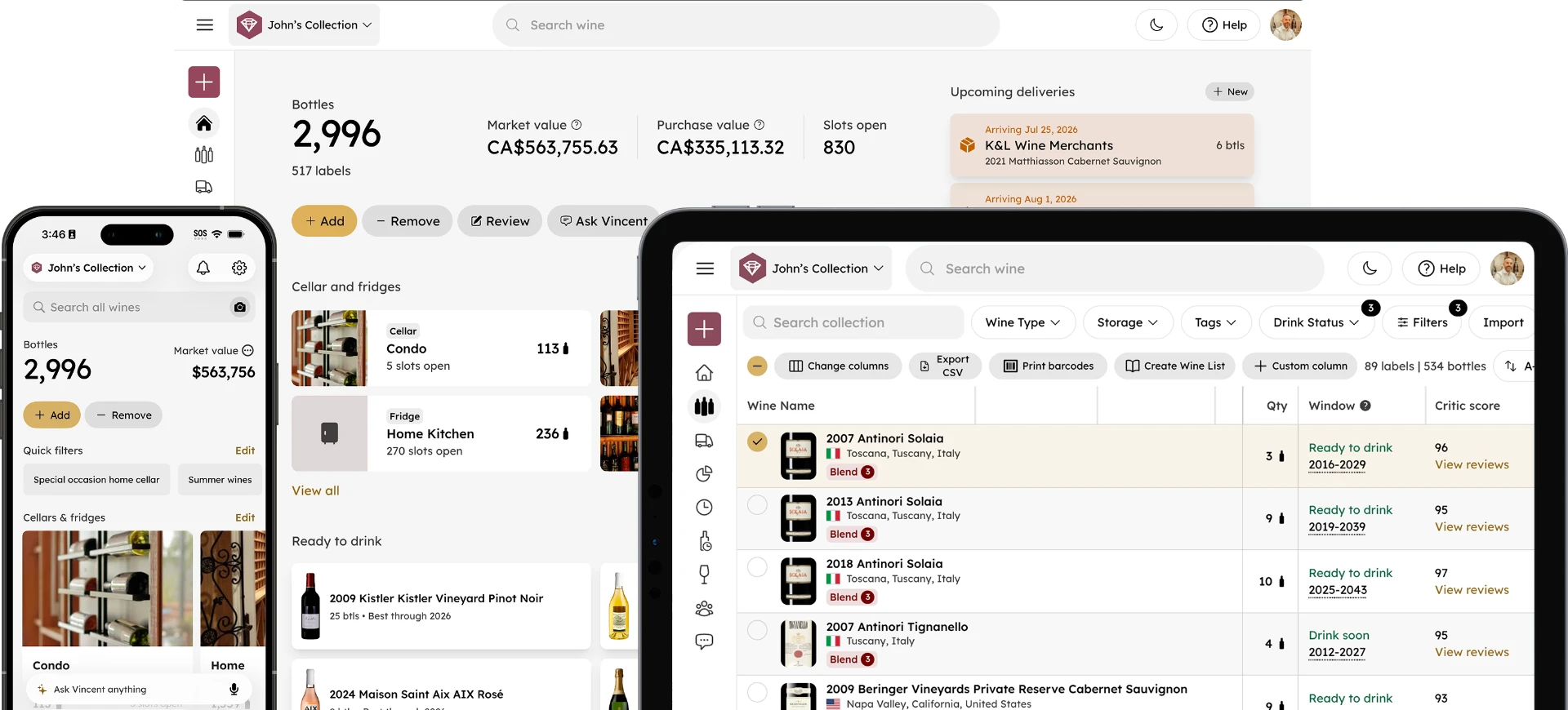
VinLocate shows exactly where a bottle sits in your cellar or wine fridge, and updates automatically when you move it.
Automatic drink windows
InVintory calculates when a bottle is at its peak and surfaces it on your home screen, so you're not researching or remembering it yourself.
Continuous valuation
Collection Analytics tracks your collection's current market value automatically, using real transaction pricing data rather than a number you researched once and forgot to update.
Less manual upkeep, not more
Adding or removing a bottle takes one action, and everything downstream (location, valuation, drink window) updates from that single entry instead of requiring separate manual updates across a spreadsheet's cells. Everything above shows up together on your home screen, not spread across separate tabs or files.
See the difference yourself: try VinLocate and Collection Analytics free →
Does switching to an app actually take more effort than keeping a spreadsheet?
No, once your collection is imported. The setup takes an hour or so for most collections. After that, day-to-day upkeep is lighter than a spreadsheet, since one action updates everything connected to it instead of requiring separate manual edits.
Is a Wine App Actually More Expensive Than a Spreadsheet?
Not necessarily. A spreadsheet costs nothing directly, but it costs time, every manual update, every price you research yourself, every drink window you track from memory. InVintory's free tier covers unlimited bottle tracking with no cost at all, and the paid tiers that add location mapping, drink windows, and automatic valuation are priced against the time they save rather than against a spreadsheet's zero dollar price tag. For collectors with 50 or more bottles, that time savings adds up quickly enough that the comparison isn't really about cost at all.
Side by Side
Setup cost
A spreadsheet is free. InVintory is free to start, with paid tiers for location mapping, drink windows, and automatic valuation.
Bottle location
A spreadsheet holds a text note that goes stale the moment you move a bottle without updating it. InVintory shows a visual map that updates automatically.
Drink windows
A spreadsheet requires manual research for every bottle. InVintory calculates and surfaces drink windows automatically.
Collection value
A spreadsheet shows whatever number you last researched and typed in, which goes out of date quickly. InVintory tracks value continuously from real market data.
Updating after a purchase
A spreadsheet needs manual entry across multiple fields. InVintory updates location, value, and history from a single action.
Access across devices
A spreadsheet depends on whatever file syncing setup you've put together yourself. InVintory syncs automatically across iPhone, iPad, and web.
Who Should Actually Make the Switch
If you're tracking a dozen bottles casually, a spreadsheet is fine, and switching isn't going to change much. If you're managing 50 or more bottles, storing wine in more than one location, or actually care about knowing your collection's current value, a spreadsheet is working against you more than it's helping. For the practical steps involved in actually moving your data over, see our migration guide, and for help deciding how to structure your collection once it's in an app, see our guide to organizing a wine collection.
The shift from a spreadsheet to a dedicated app isn't about abandoning something that works. It's about recognizing which questions a static list can never answer, no matter how carefully you maintain it.
See what your collection looks like with real tracking behind it.
FAQ
At what collection size should I stop using a spreadsheet?
Most collectors feel the limits somewhere between 30 and 50 bottles, when it becomes hard to recall the full collection from memory and a spreadsheet alone stops being enough to manage it well.
Can a wine app do everything a spreadsheet can?
Yes, and more. Anything you'd track in a spreadsheet (producer, vintage, quantity, notes) has a place in a wine app, plus location mapping, drink windows, and valuation that a spreadsheet can't provide.
Is it hard to switch if I've used a spreadsheet for years?
No. Exporting your spreadsheet and importing it takes most collectors under an hour. See our full migration guide for the exact steps.