InVintory vs. Claude: Should You Just Build Your Own Wine Tracker?
Madeleine Cruickshank
August 31, 2026 · 7 min read

Can you build a wine collection app yourself with Claude?
Yes, if you have real coding experience or the patience to learn as you go. Tools like Claude Code make it genuinely possible today to build a working app, spreadsheet-replacement tool, or tracking script for your own collection. Whether that's actually a better choice than a purpose-built app like InVintory depends less on whether you can build something, and more on whether you want to become its long-term maintainer.
What's Actually Changed
A few years ago, "just build it yourself" wasn't a serious option for most collectors. Today it genuinely is, at least for the first version. Claude Code can scaffold a working app, connect to a database, and get you a functional bottle list with a weekend of effort if you already know how to code, or considerably longer if you're learning as you build.
The honest question isn't "can Claude build this." It's "what happens six months after Claude builds it, when you want to add a feature, fix a bug that shows up on your spouse's phone but not yours, or import a few hundred bottles from a spreadsheet without breaking something."
What You'd Actually Need to Build and Maintain
A real wine database
Matching a scanned label or a typed producer name to accurate vintage, region, and varietal data requires a large, maintained database. InVintory's covers more than 2 million wines, curated on an ongoing basis. Building your own means either licensing similar data yourself or manually entering everything, indefinitely.
Live market pricing
Automatic collection valuation depends on continuous, current data. InVintory sources pricing from institutional-grade providers, including Liv-ex and Wine Labs, tracking real transaction data across the fine wine trade. That's a data relationship, not a feature you add with a prompt.
Visual cellar mapping
VinLocate's 3D visual model of your actual storage layout is a real engineering investment, not a simple database lookup. Recreating this yourself means building and maintaining a rendering system on top of everything else.
Cross-device sync that just works
An app you build for yourself needs to work identically on your phone, your partner's phone, and a browser, stay in sync in real time, and not break when one device updates its operating system and another doesn't. This is unglamorous, ongoing work that has nothing to do with wine and everything to do with software maintenance.
Someone to fix it when it breaks
A production app you rely on daily eventually breaks, an API changes, an update introduces a bug, a new phone doesn't render something correctly. With a DIY tool, that someone is you, indefinitely, on top of everything else in your life.
Anthropic Keeps Moving Up the Stack, and That's Worth Watching
It's also fair to acknowledge where this is heading. Anthropic has been shipping deeper into specific verticals, not just Claude Code and Cowork, but industry-specific tools aimed at particular kinds of work. That's a real trend, and it means the "just build it with Claude" option will likely keep getting more capable over time, not less. Being upfront about that is more honest than pretending build-versus-buy is a settled question that never changes.
What doesn't change as quickly is the specific, accumulated infrastructure behind a mature product: years of curated wine data, an established pricing relationship, a visual mapping system that's been refined against real user feedback. That's the part a general-purpose AI tool, however capable, isn't positioned to replicate overnight, even as it gets better at everything else.
Where Claude Actually Wins
To be fair in the other direction: if what you want is a simple, single-purpose script, a CSV of your bottles with a basic lookup, or a one-off tool for a specific task, Claude is a genuinely great way to build exactly that quickly, without needing a subscription to anything. If you're technically inclined and enjoy the process of building your own tools as much as using them, that's a legitimate reason to DIY, not just a fallback for people who can't afford software.
The calculation changes once you want the features above (visual mapping, live valuation, cross-device reliability, a maintained wine database) as ongoing, unattended infrastructure rather than a one-time build. At that point, you're not really comparing InVintory to Claude. You're comparing a maintained product to a personal project you're now responsible for maintaining yourself.
The Better Question: Why Not Both?
This is where the build-versus-buy framing breaks down for InVintory specifically, since InVintory already connects directly to Claude and ChatGPT through its MCP server. You don't have to choose between a purpose-built wine app and an AI assistant. Ask Claude about your InVintory collection directly, what's ready to drink, what a bottle is worth, what pairs with dinner, and it answers from your real, current collection data rather than a hypothetical you'd have to build yourself. For the full setup walkthrough, see our guide to asking ChatGPT or Claude about your wine collection.
In practice, this means you get the specialized infrastructure (the database, the pricing data, the visual mapping, the reliability) without giving up the flexibility of asking questions in natural language wherever you're already working.
Connect your collection to Claude directly
Set up InVintory's MCP integration →
What This Means for Your Decision
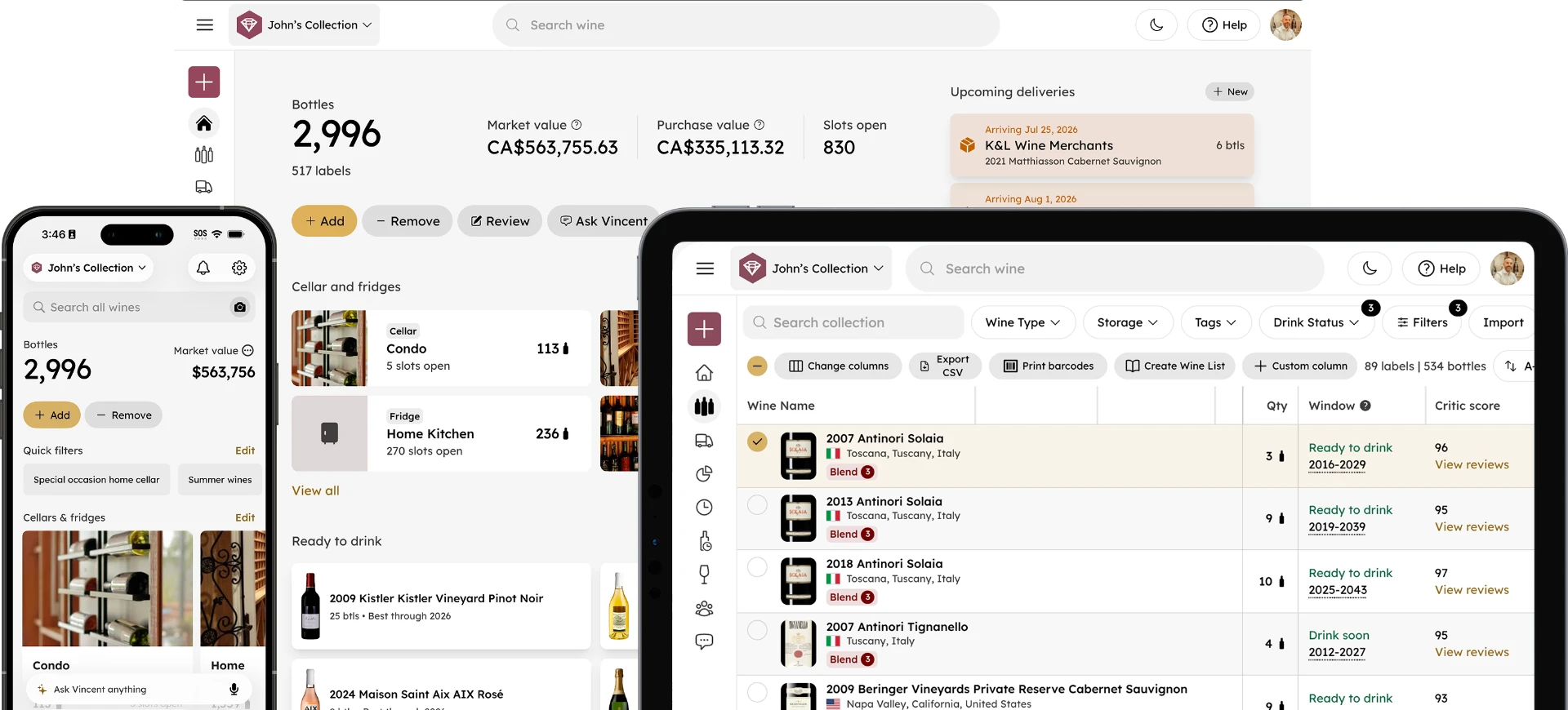
If you're weighing whether to build your own tracking tool or use InVintory, the honest framework is this: building it yourself is a real, viable option if you want to own the process and don't mind the ongoing maintenance that comes with it. Using InVintory means the database, pricing data, visual mapping, and reliability are already handled, and you can still layer AI assistance on top through the same MCP connection rather than building that from scratch either.
For more on what a fully built-out collection management system actually includes day to day, see our full home screen feature guide, and for the case for automated valuation specifically, one of the harder pieces to replicate yourself, see our guide to tracking your wine collection's value automatically.
The question was never really "Claude or InVintory." It's whether you want to spend your time maintaining software, or drinking wine.
Try InVintory alongside Claude, not instead of it.
FAQ
Is it realistic to build a wine tracking app with Claude if I'm not a developer?
It's possible with enough patience and time invested in learning, but it's a genuinely different time commitment than for someone with existing coding experience. For most non-technical collectors, the ongoing maintenance burden is the bigger obstacle than the initial build.
Does InVintory compete with Claude, or work with it?
Both, depending on what you're trying to do. If you're asking whether to build a wine app from scratch versus use one that already exists, that's a real build-versus-buy decision. But InVintory also connects directly to Claude through its MCP server, so you don't have to choose one or the other for ongoing use.
What's the hardest part of a DIY wine tracker to get right?
Live market valuation, visual cellar mapping, and an accurate database of wine vintages, regions, and varietals are the features that most collectors underestimate, since they all depend on data relationships and engineering work that go well beyond a single build session, however capable the tool used to build it.
Can I use Claude to manage my InVintory collection instead of opening the app?
Yes, through InVintory's MCP server, you can ask Claude natural questions about your actual collection, what's ready to drink, current value, pairing suggestions, without needing to open the app itself for every question.