Scaling a Wine Collection Past 100 Bottles
Madeleine Cruickshank
May 27, 2026 · 5 min read
What changes once a wine collection passes 100 bottles?
Past about 100 bottles a collection stops being a list and starts being a portfolio, and the problems change from what to buy to what you already have too much of. Memory stops working as an inventory system, storage space becomes a real constraint rather than a hypothetical one, and buying decisions start requiring context about what is already in the cellar rather than just what looks interesting on a shelf.
If you have not hit that wall yet, starting from scratch covers the earlier stage well: building initial habits, picking your first regions, getting basic storage sorted. This page picks up from there, a cellar with real size, and the question of how to keep it useful as it keeps growing toward 250 or 500 bottles.
What Changes at Each Stage
The jump from 100 to 500 bottles is not linear. Each stage breaks in a different way, and the fix that works at one stage is not always what the next one needs.
100 bottles: memory stops being a reliable inventory system, and drinking windows start actually colliding, bottles bought years apart all reaching their peak around the same time. A basic tracking habit, even a simple one, becomes necessary rather than optional.
250 bottles: storage capacity gets tested directly, and the tension between buying breadth (new regions, new producers) and depth (more of what you already know you love) becomes a real tradeoff rather than an abstract one. This is also where a spreadsheet most commonly starts failing: too many rows to scan quickly, no live pricing, and no way to see what is actually ready to drink without opening the file and doing math.
500 bottles: the collection functions as a portfolio rather than a shelf. Selling or rotating out bottles that no longer fit becomes a normal part of maintaining it, not an exception. At this size, professional-grade tracking, automatic valuation, drink window calculation, and a way to actually find a specific bottle physically stop being a convenience and become the only way the collection stays usable.
What Breaks First at 100 Bottles
The first thing that breaks is memory. At 50 bottles you can walk your cellar and roughly recall what is there and roughly when it is ready. At 100, that recall gets unreliable, and past it, you are relying on habit and hope rather than actual knowledge of your own collection.
The second thing that breaks is drinking window coverage. Bottles bought at different times, often years apart, start reaching their peak windows in overlapping clusters, which means you either drink through a cluster too fast to enjoy it properly or miss the window on bottles you forgot you had.
Neither of these is a storage problem or a buying problem. Both are tracking problems, and they show up before storage capacity or budget ever becomes the binding constraint.
Build a Balanced Cellar
How should a collection past 100 bottles be structured?
A balanced cellar at this size covers three time horizons at once: bottles ready to drink now, bottles approaching their peak in the next two to five years, and bottles built for long-term aging. Past 100 bottles, all three categories are populated simultaneously, which is exactly why tracking matters more here than it did at 50.
Most collectors in the 100 to 500 bottle range converge on some version of this split:
- 40 to 50 percent: drinking bottles you will open within the next one to three years
- 30 to 40 percent: bottles in the two to seven year aging range
- 10 to 20 percent: long-term holds built for aging beyond seven years
Adjust those ratios based on your collecting philosophy. A collector focused on investment will weight the long-term hold category higher. A collector who entertains frequently will weight the drinking bottles higher. For more on what actually drives a bottle's trajectory from everyday drinker to long-term hold, see our guide to which wines actually hold their value.
Buy with Intention at Scale
How do serious collectors decide what to buy once they are past 100 bottles?
The collectors who build great cellars over time share one habit: they buy with a specific gap in mind rather than opportunistically. Past 100 bottles, that gap is something you can actually check against a real record instead of guessing.
When evaluating a purchase, ask:
- Does this bottle fill a gap in my drinking window coverage?
- Am I over-indexed in this region or varietal already?
- Is this a producer I have reason to trust over multiple vintages?
- Does this fit my philosophy for drinking, aging, or investing?
What's a reasonable buying cadence and budget once a collection is established?
There is no universal answer, but collectors who scale well tend to buy on a regular, modest cadence rather than in occasional large batches. A steady rhythm, monthly or quarterly for most people, gives you time to actually taste and evaluate what you already have before adding more, and it keeps buying decisions tied to real gaps rather than whatever caught your eye that week. Large, infrequent buying sprees are where over-indexing in one region and accidental duplicate purchases both tend to happen, precisely because there is no pause to check what is already in the cellar.
Devote at least 25 percent of your collection to wines you'd like to try that are new to you. This ensures you don't miss out on discovering your next favorite. The collector who only buys what they know never evolves their palate. The collector who only buys the unfamiliar never builds depth in the producers they love. The balance between those two instincts is what makes a collection interesting over time.
Horizontal Depth vs Vertical Depth
Should you buy more producers or more vintages of the same producer?
Both, but deliberately rather than by accident. Horizontal depth, more regions, more producers, more styles, keeps a collection interesting and hedges against your own taste changing over time. Vertical depth, multiple vintages of a producer you already trust, builds real expertise in how that producer's wine changes with age and lets you track how a specific site performs across different growing seasons.
Early in a collection, horizontal depth usually wins by default, since you are still figuring out what you like. Past 100 bottles, it is worth deciding deliberately whether to keep expanding outward or start building real vertical depth in a handful of producers you have confirmed you love. Most well-regarded collections lean vertical in a small number of areas and horizontal everywhere else.
Know What You Own
Why does tracking matter more past 100 bottles?
At 50 bottles, you can hold your collection in your head. At 200, you can't. At 500, the difference between a collector who tracks carefully and one who doesn't is measured in bottles opened past their peak, duplicates bought accidentally, and money spent on wines already well represented in the cellar.
A valuable wine collection should be properly documented. Organized receipts, inventory records, and routine appraisals are necessary to ensure that each wine in your cellar is counted, still drinkable, and has been valued at its most current market rate.
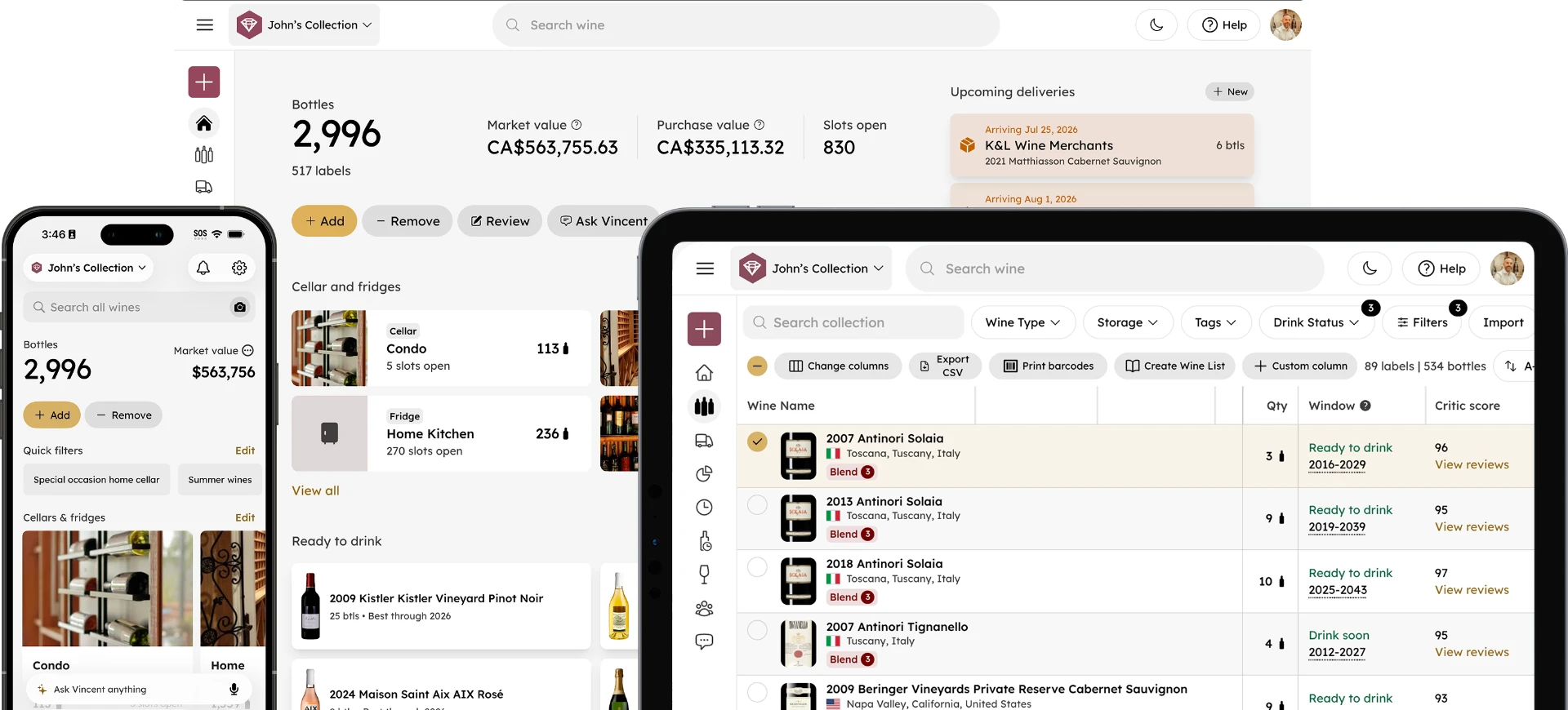
InVintory gives you the tracking infrastructure that grows with your collection. Every bottle has a precise location mapped through VinLocate, a drinking window tracked automatically, and a market value updated from institutional-grade pricing data. The Ready to Drink feature surfaces bottles currently in their peak window so nothing gets missed. Collection Analytics shows you how your cellar is distributed by region, how much you've spent, and what your collection is worth today.
For how to actually organize a large collection so a specific bottle can be found quickly, see our guide to organizing a wine collection, and for naming conventions that hold up as a collection scales into the hundreds, see our cellar organization framework.
Start Tracking Your Collection in InVintory →
When does a spreadsheet or a free tracking plan stop working?
Most collectors notice a spreadsheet breaking somewhere between 150 and 300 bottles: too many rows to scan at a glance, no live pricing so the value column is always stale, and no way to see what is actually ready to drink without manually checking each vintage against its drinking window. A free tracking plan tends to hit its own wall around the same range, usually a bottle cap or a missing feature like visual cellar mapping or automated valuation, rather than a hard number.
The tell is not a specific bottle count. It is the moment checking your own collection starts taking real effort instead of being instant.
For collectors who have been managing their collection in a spreadsheet, this post on why collectors upgrade from spreadsheets to apps explains exactly where manual tracking breaks down at scale.
Storage at This Scale
If you are past 100 bottles, storage is presumably already solved in some form, and the real question is whether it is still adequate for what you are holding now. If you are ready to move beyond a fridge or cabinet into a dedicated space, see our guide to building a wine cellar at home.
Review Your Collection Regularly
How often should an established collection be audited?
At minimum, once a year. A collection that isn't reviewed regularly drifts: bottles age past their window, your tastes shift away from regions you once prioritized, and the structure you intended when you started buying gets overwritten by opportunistic purchases.
An annual review should cover four questions: What is ready to drink and needs to be scheduled for opening? What has appreciated enough to consider selling? What gaps exist that your next purchases should fill? What no longer fits the collection and should be gifted, sold, or consumed soon? For the fuller decision framework on any specific bottle, see our guide on when to drink, sell, or hold.
InVintory's Collection Analytics and Ready to Drink list make this review straightforward. The data is already there; the review is just the act of looking at it deliberately and making decisions from it.
When should you stop buying and focus on what you have?
There is no universal bottle count where buying should stop, but there are real signals: storage capacity maxed out, drinking windows piling up faster than you can work through them, or a growing share of the collection sitting in categories you no longer care about. When two or more of those show up at once, the right move for a while is usually to buy less and drink and rotate more, rather than solving a storage or organization problem by acquiring your way past it.
This is exactly what an annual review is for: catching that moment before it becomes years of accumulated drift.
For collections at the higher end of this range, InVintory Elite adds deeper reporting and custom cellar modeling built for portfolios this size.
A great collection isn't built in a single buying spree. It's built one deliberate decision at a time, over years of learning what you love and building a cellar that reflects it.
Compare Free, Premium and Elite →
Frequently Asked Questions
How many bottles should a collection have before scaling strategies matter?
There's no standard answer; it depends entirely on your lifestyle, storage capacity, and collecting philosophy. Most collectors start feeling the changes described on this page somewhere around 100 bottles, when memory stops being a reliable inventory system and drinking windows start overlapping. From there, growth should be driven by gaps in your collection rather than a target number.
How do I track my wine collection as it grows?
InVintory tracks every bottle's location in your cellar or wine fridge, drinking window, market value, and history automatically. As your collection grows, the app scales with it, giving you the same level of visibility at 500 bottles that you had at 50. Get started with InVintory free to see how it works.
How do I know when my wine is ready to drink?
InVintory calculates drinking windows for every bottle in your collection and surfaces bottles currently in their peak window through the Ready to Drink list on your home screen. You can also check producer notes and critic assessments for any bottle through the Wine Guide.
When should I sell instead of keep buying?
When storage is maxed out, when drinking windows are piling up faster than you can work through them, or when a growing share of the collection sits in wines you no longer care about. Any one of those is worth noting; two or more at once is a real signal to slow down buying and focus on what you already have. See our guide on when to drink, sell, or hold for how to make that call bottle by bottle.